A future to protect
Despite UNESCO’s recognition, bell ringing today faces a crucial challenge to its survival. The advent of automated systems has reduced the number of practising bell ringers, threatening the survival of centuries-old techniques.
In Umbria, the towns of Gubbio and Arrone still stand as guardians of this tradition, showing the world that ancient art forms can still stir emotions and forge connections. Their passion is an invitation not to let this heritage fall into silence.
The “Campanone” of Gubbio: a unifying symbol
In Gubbio, about fifteen bell ringers are active, and becoming one requires an apprenticeship with the local group. Upon completion, the new ringer earns the iconic red shirt, officially joining the “Compagnia dei Campanari di Gubbio” (Company of Bell Ringers of Gubbio), formally established in 1981,but in reality, existing for centuries.
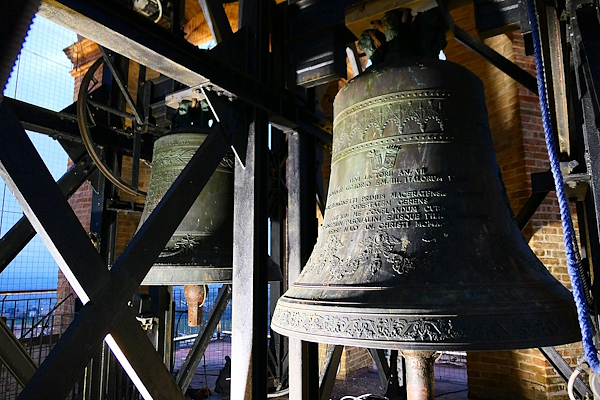
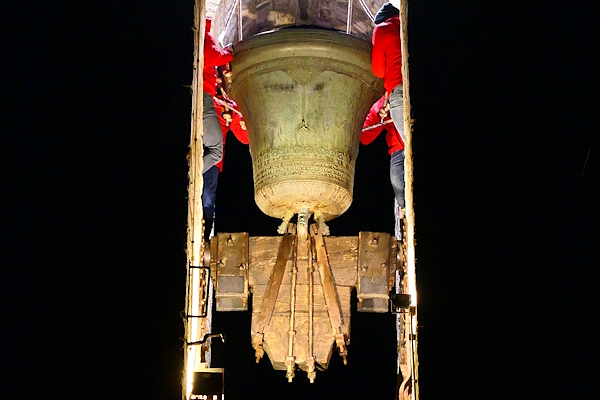
The grand “Campanone” (Big Bell) of the Palazzo dei Consoli, installed in 1769, is a symbol of the city and a key icon of the Gubbio tradition. Standing over 2.5 meters tall and weighing nearly two tonnes, it is more than a monument — it is a living element of local culture. Each year, during the Festa dei Ceri, the sound of the bell accompanies the event, uniting the community in a moment of shared celebration.
Ringing the Campanone is not just a technical act — it is an emotional experience that deeply involves both the ringers and the audience.
Arrone: bell ringing among medieval villages
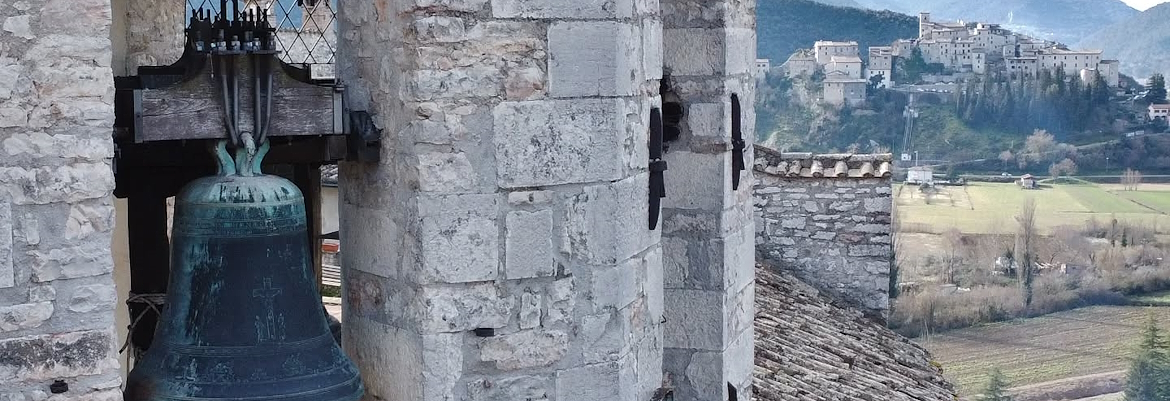
In Arrone too, the art of bell ringing is also deeply embedded in local identity. In 2002, the “Gruppo Campanari Arrone”(Arrone Bell Ringers Group) was formed, with the initial goal of bringing back the sound of the ancient bells of the Church of San Giovanni Battista.
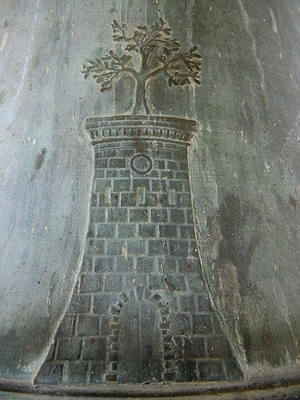
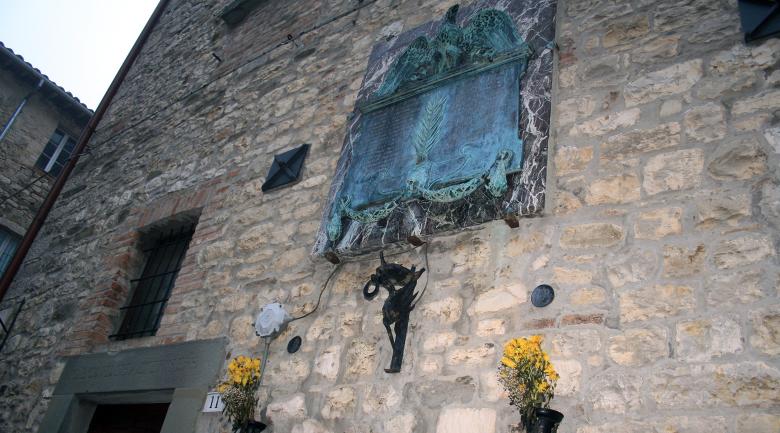
Its belfry houses multiple bells. At the centre is the main bell, adorned with detailed bronze reliefs depicting the town’s patron saint and the Civic Tower of Arrone, topped with a wild olive tree that grew there spontaneously — a powerful symbol of resilience and tradition.
Alongside the main bell are three other bells: the midday bell; the medium bell that once signalled the start of school for local children; and the smallest, which once summoned the townspeople to assembly. An inscription on the latter recalls its recasting after being destroyed during the 1799 uprising.
Fun fact: the “a bicchiere” bell ringing technique
Bell ringing combines strength, rhythm, and physical expression in a centuries-old dialogue between body and bronze.
In Umbria, a mixed technique is used, combining stationary bells played with a clapper and the grand swinging of the big bell.
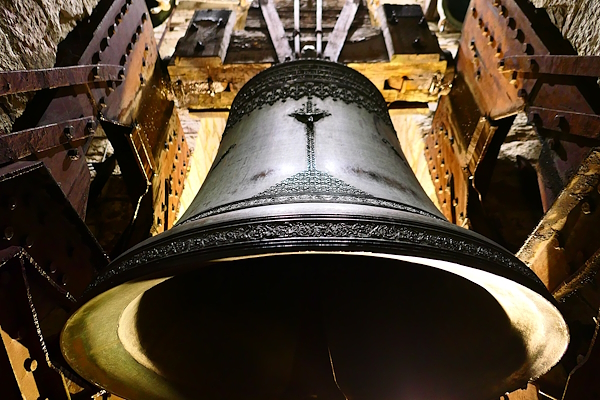
But what truly sets Umbrian bell ringing apart is the spectacular “a bicchiere” (by glass) technique, where the bell ringer, with a precise and athletic movement, flips the bell to a vertical position, with its mouth facing the sky. This manoeuvre, which involves both arms and feet, is one of the most demanding and breathtaking techniques, proving that bell ringing is a true heritage of physical skill, coordination, and living tradition.
Every sound and movement tells an ancient story — with the bell ringer’s body as its interpreter, a bridge between past and future.
Bells that tell stories and legends
Beyond Gubbio and Arrone, other places in Umbria have their own stories and legends about their bells:
- Bell of Saint Emiliano: it is said that the night the Trevi’s patron saint was beheaded in 304, a bell rang on its own. The sound was so powerful it was heard throughout the region.
- Bells of the Monastery of Santa Maria Maddalena: On May 22, 1457, the day of Margherita Lotti’s death – who would later be canonised as Saint Rita –the bells of the monastery of Cascia began to ring, as if moved by invisible hands.
- Bells of Montone: In 1473, when Carlo Fortebracci, son of the famous condottiero Braccio da Montone, donated a relic of the Holy Thorn to the town, the bells rang spontaneously. This event is still commemorated each year during the Festa della donazione della SantaSpina(Feast of the Donation of the Holy Thorn).
- Bell of the Madonna delle Scentelle (Grotti): It is said that in Grotti, a hamlet of Sant’Anatolia di Narco, a woman threw her gold into the casting of a bell destined for the rural church, as thanks for a grace received. Although the bell was later stolen, some still remember its unmistakeable sound.
- The bell ringer of Ferentillo: At the town’s Museum of the Mummies, it is said that one of the preserved bodies belongs to a bell ringer who tragically died falling from the belfry while ringing the bells for his beloved.















.jpg/e9571273-0e35-1ff2-0713-76c7fd4e3cc5?width=456)