





.jpg/e9571273-0e35-1ff2-0713-76c7fd4e3cc5?width=456)

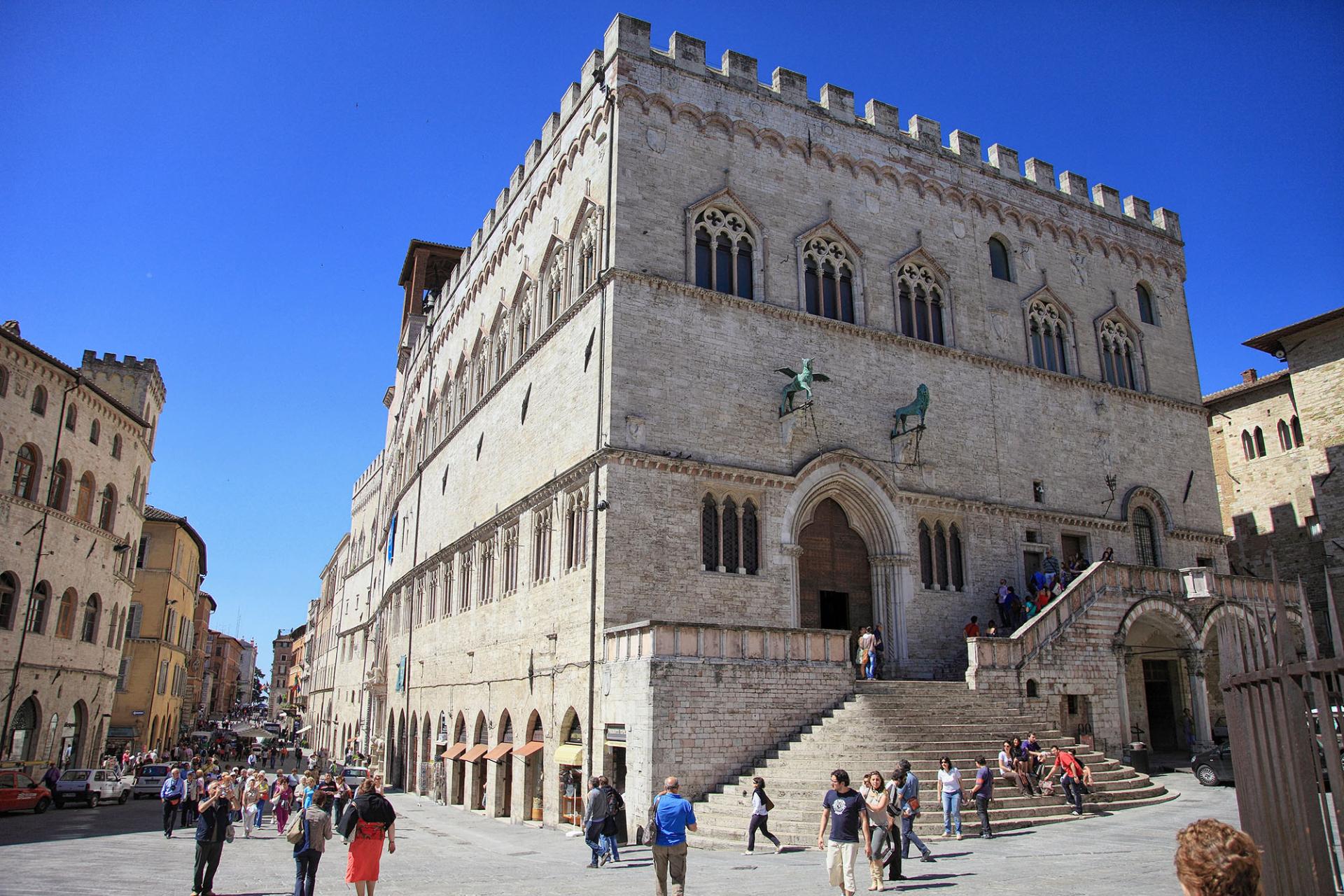
Palazzo dei Priori - Perugia
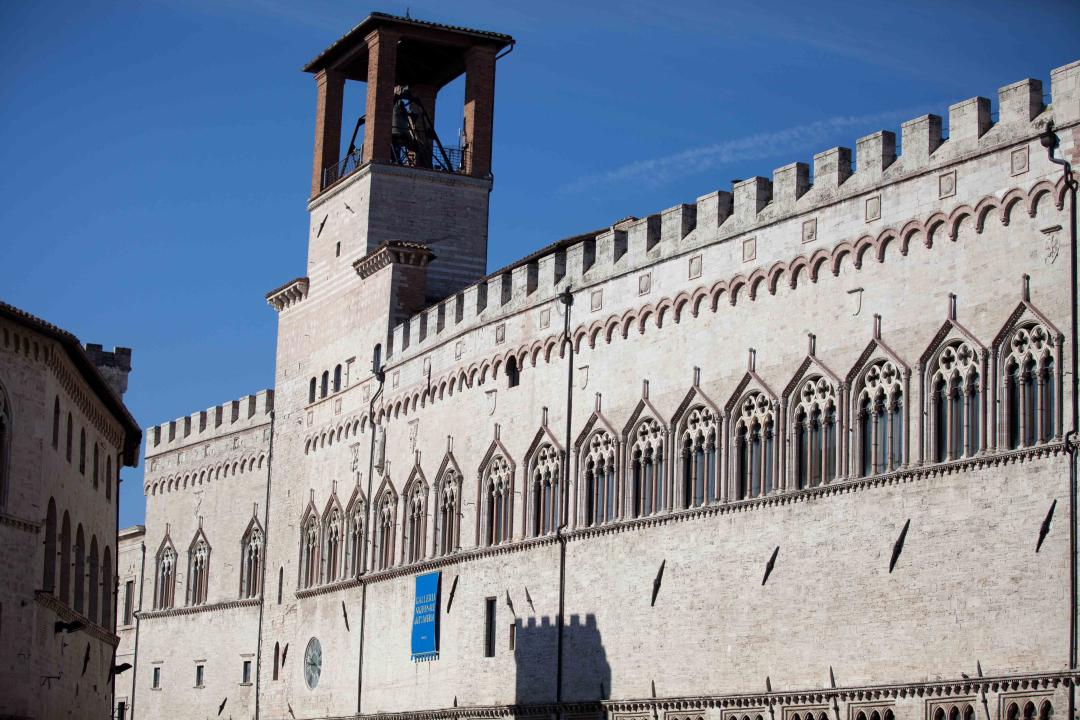
Considered among the finest Gothic buildings in Italy, Palazzo dei Priori has been—and still is—the seat of Perugia’s public administration. It stands in the very heart of the Umbrian city, in that platea communis which has always been its centre. Although the result of the merging of different construction phases and several building units, it appears as a unified structure: an elegant succession of triple lancet windows and decorative elements that make it resemble a precious lacework framing the southern side of today’s Piazza IV Novembre.
Multiple buildings, one single heart for governing the city
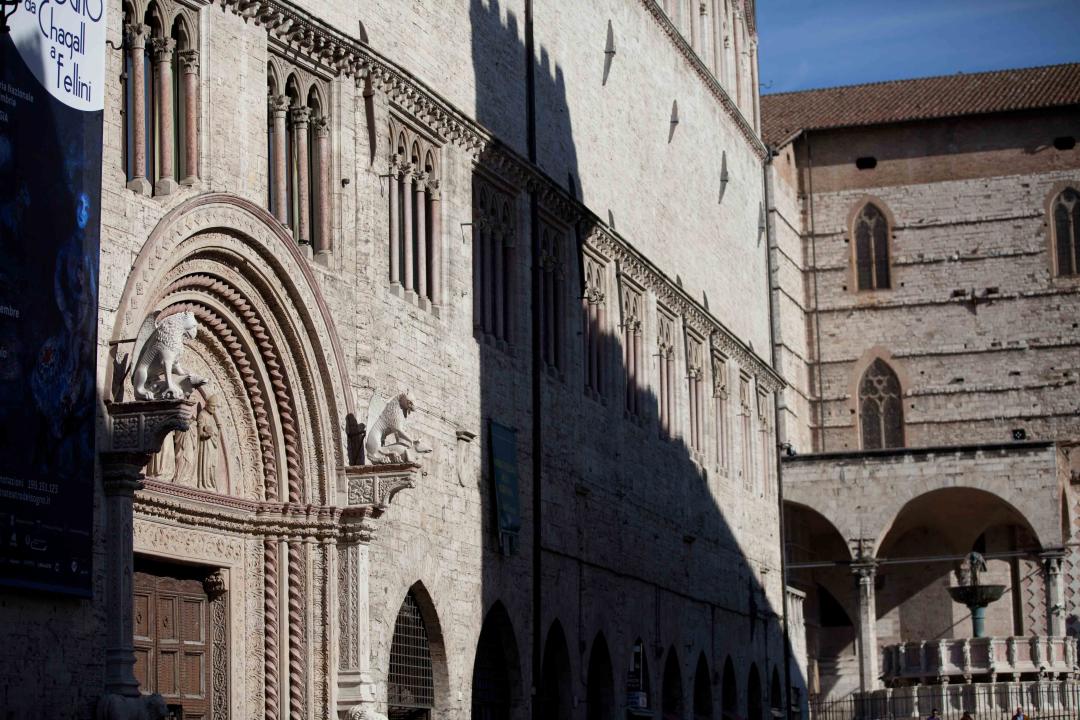
The first nucleus of the palace dates back to 1292. According to historical sources, it consisted of a very simple structure: two vast superimposed halls—almost like two covered squares—intended for public assemblies. A few years later (1294), the hall on the first floor became the Sala del Capitano del Popolo, today the Sala dei Notari, connected to the magistrate’s residential quarters. Of this original 13th-century structure remain the three beautiful triple lancet windows on the second floor and the portal facing the square, which at the time was located at the centre of the building, as well as the ten triple lancet and four lancet windows along the palace façade overlooking Corso Vannucci.
The palatium novum populi, as it appears in contemporary documents, was subsequently expanded in successive phases by incorporating several private buildings. In the 14th century, with the establishment of the magistracy of the Priori, a larger structure became necessary—one that could house the ten administrators (two for each city district or “Porta”) for the entire duration of their term of office, which generally lasted two months and was spent entirely within the palace in a sort of political seclusion, from which they could leave only for public ceremonies. Furthermore, the demographic growth and the economic and social development of Perugia required a more articulated administrative structure, with additional spaces for offices, archives, and more.
Between 1317 and 1326, the palatium priorum was built, most likely designed by the Sienese architect Ambrogio Maitani. This phase saw the construction of the splendid main portal on the side facing Corso Vannucci. In 1323, the public palace reached the current Via dei Priori, “overpassing” it with a covered archway. In the years immediately following, the bell tower was erected and the first Cappella dei Priori (Chapel of the Priori) was built, dedicated to Saint Louis of Toulouse, brother of the King of France Charles of Anjou, a powerful ally of the Perugia: indeed, the French fleur-de-lis appears on the lunette of the portal facing Corso Vannucci and in the masonry along Via dei Priori. Around 1335, the façade on the square side was expanded, incorporating the medieval church of San Severo and adding a portico with arches in front of the original structure—an intervention that caused the loss of the façade’s original symmetry. On this occasion, a new staircase was built (the current semicircular one dates to 1902).
Between 1429 and 1443, the building was further expanded to the south, on the side facing the Corso. The small church of San Giovanni “de Foro” was incorporated into the palace and today forms part of the Collegio del Cambio. The major guilds of the city, in fact, were granted the privilege of being housed within the communal palace: the Collegio della Mercanzia (Merchants’ Guild) obtained such a seat in 1390, while the Money Changers' Guild were admitted in 1452; both powerful guilds created splendid headquarters in their allotted spaces.
Starting in 1534, the palace became the seat of the papal legate, and some rooms in the more recent wing were adapted for this purpose. Specifically, between 1545 and 1548, when Pope Paul III Farnese appointed Tiberio Crispo as papal legate, a luxurious apartment was created for him on the second floor, while on the third floor Tommaso Bernabei, known as “il Papacello”, frescoed the “Sala della Congregazione governativa per la state” (Hall of the Governmental State Congregation).Another important intervention was carried out by the architect Galeazzo Alessi, who built a beautiful loggia around 1580, while the architect and sculptor Vincenzo Danti had designed the monumental staircase between 1570 and 1574. Between the 17th and 19th centuries, periods strongly marked by papal rule, the palace underwent numerous alterations. It was completely restored and returned to its original form only after the Unification of Italy, when it became the seat of the Municipal Administration. From 1879 onwards, the third floor housed the Municipal Art Gallery “Pietro Vannucci”, today the National Gallery of Umbria.


.jpeg/8031dd9b-06c7-4ac1-a77b-86e1376416b6?width=780)