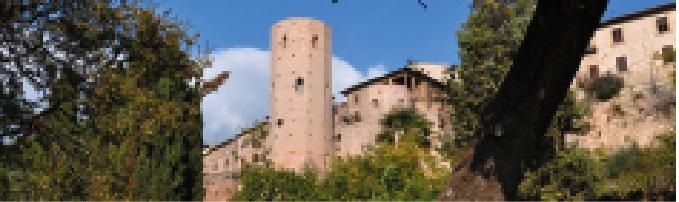





Panoramic view of Castello del Poggio nestled in the greenery of the Umbrian hills, with rolling countryside in the background.

Castello del Poggio - Guardea

Perched with austere majesty atop a solitary hill, the Castello del Poggio rises against the skyline as a silent witness to centuries of history. Its origins date back to the 7th century, when a Byzantine stronghold guarded these heights. In 1034, the Normans transformed it into an imposing fortress. In the 16th century, the architect Antonio da Sangallo the Younger redefined its essence, converting it from a military bastion into an elegant noble residence enriched with superimposed loggias and Renaissance courtyards.

A crossroads of history and power: echoing footsteps of the great

Within the castle walls, legendary figures have passed through: Frederick Barbarossa trod its stones during his imperial campaigns; Charles V left his mark with the toppling of a tower; Cesare Borgia gifted it to his sister Lucrezia as a token of power. Others include Olimpia Pamphili, sister-in-law to Pope Innocent X and a cunning figure of Baroque Rome, and Galileo Galilei, who found refuge here from persecution.

Architecture: a masterpiece of stratification

The castle unfolds like a living organism, adapting to the morphology of the hill with brilliant military sensibility. Byzantine cores, Norman towers, Renaissance extensions and loggied courtyards blend into a harmonious whole, enclosed by triple rings of turreted walls. Inspired by Crusader fortresses like Krak des Chevaliers, it stands as a rare example of a machicolated defensive castle, where every detail reveals the advanced engineering of the High Middle Ages.

Between fiefdoms and legends

Originally an imperial outpost, the fortress eventually came under the dominion of the Status Alviani, becoming the Church’s stronghold against Todi. Its towers watched over trade routes to the Tiber Valley. The very name Guardea likely derives from guardigium—a tribute paid to lords in exchange for protection. Sieges, treaties, and brief periods of autonomy marked its history, until its post-Renaissance decline and its late 19th-century revival as an Art Centre by actor Jimmy Savo, who spent his final years there.

A timeless heritage

Declared a National Monument for its exceptional historical and architectural value, the Castello del Poggio is today an international historic residence and the seat of the Club of Budapest. Its terraces offer breathtaking views over the Alviano Oasis, while its interiors—with frescoed fireplaces bearing Savoy crests and loggied courtyards—embody the essence of an Italian rarity.

Explore the surroundings
Main attractions in the vicinity