




.jpg/e9571273-0e35-1ff2-0713-76c7fd4e3cc5?width=456)

Complex of San Francesco in Montone
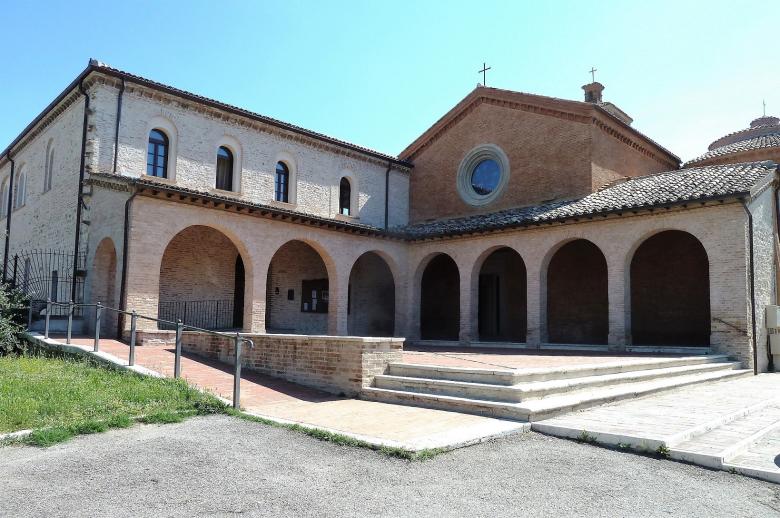
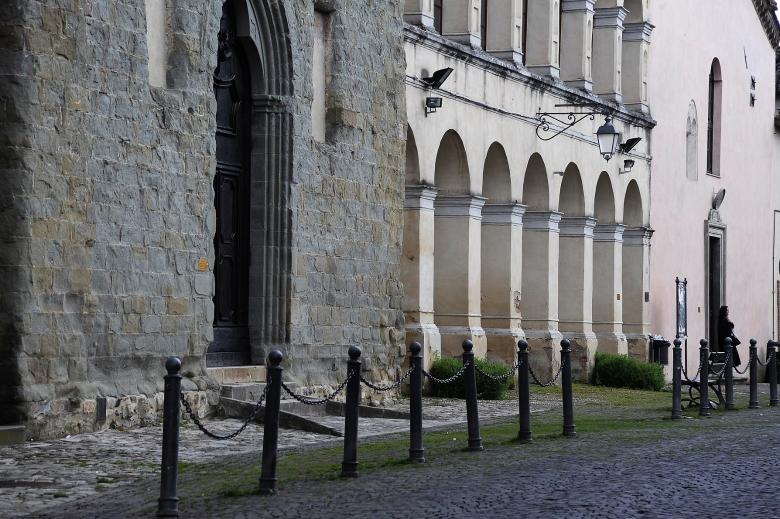
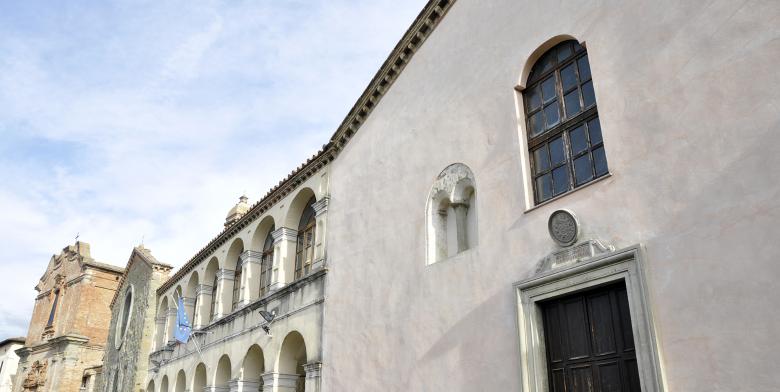
The Complex of San Francesco is a former Franciscan settlement dating back to the 14th century, built in the upper part of the village of Montone, in the district known as Borgo Vecchio. It consists of the Gothic church, the picture gallery housed in the rooms of the former Franciscan convent, the MuMO – Museum of San Francesco of Montone, located in the ground-floor rooms, and a cloister dating from the 16th–17th century.
From Franciscan simplicity to the splendour of a family of condottieri: the Church of San Francesco
The church was built in the 13th century on the site of the houses of the Olivi and Fortebracci families, in the simple forms befitting a Franciscan church: a single nave, with a polygonal apse and trussed roof, allowing the faithful to gather in prayer and ensuring that the celebrant’s voice could reach those attending the divine Offices without impediment. About a century later, it became the appanage of the powerful Fortebracci family, who held lordship over the territory and adorned it with rich decorations as a testament to their prestige and wealth.In particular, it was Braccio Fortebracci, the famous condottiero and Lord of Perugia from 1416 to 1424, who commissioned the frescoes of the apse area from the painter Antonio Alberti of Ferrara, an artist active at the Este Court in Ferrara. Thanks to the patronage of the family and its followers, artists of the calibre of Luca Signorelli, Bartolomeo Caporali, Benedetto Bonfigli and others came to work in this simple Franciscan church. In the 16th century, a new wing of the convent was added on the north side of the building, enlarged to meet the growing needs of the convent community. Long neglected in the modern age, the church has since been carefully restored and today forms the heart of the museum complex of San Francesco, inaugurated in 1995.
A visit to the church…
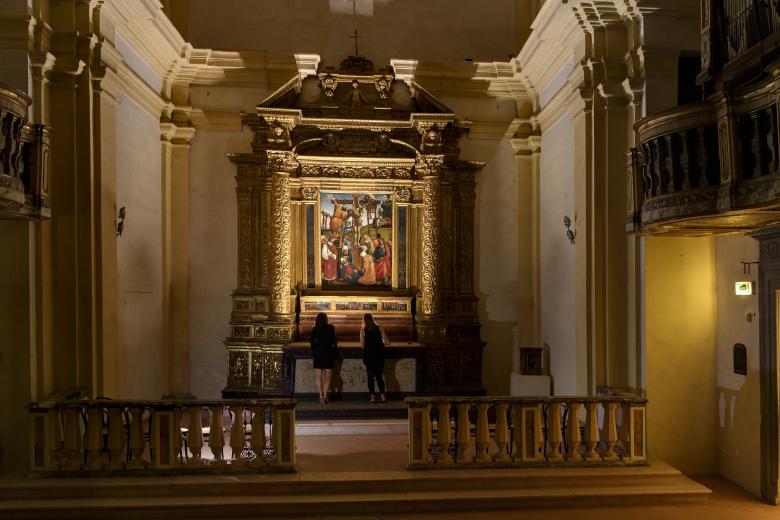
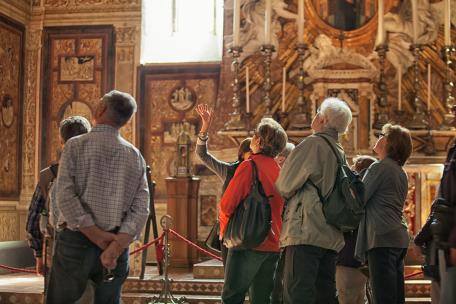
The single nave is illuminated by the light filtering through the single-lancet windows of the side walls and the three windows, including a central mullioned window, opened onto the polygonal apse.
This apse is decorated with frescoes, unfortunately fragmentary, commissioned by Braccio da Montone from Antonio Alberti of Ferrara between 1422 and 1424, depicting episodes from the life of Saint Francis and scenes of the Last Judgement. Also of considerable interest is the wooden choir dating from the late 15th century.
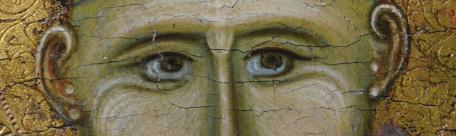
On the counterfaçade and along the left wall are fragments of frescoes dating from the 14th and 15th centuries, including a face of Saint John the Baptist (attributed to Berto di Giovanni, a pupil of Perugino), a Martyrdom of Saint Sebastian, and a scene of the Supper in the Pharisee’s House. On the same wall stands a stone altar, created in the 15th century at the behest of Count Carlo Fortebracci as a votive offering for the birth of his son Bernardino, later decorated by the Perugian painter Bartolomeo Caporali with a fresco depicting Saint Anthony of Padua between the Baptist and the Archangel Raphael leading Tobias by the hand. On this same wall is also the Magistrates’ Bench, made of carved and inlaid wood with motifs inspired by grotesques by an anonymous 16th-century artist; it was Father Guardian Stefano Cambi who commissioned the bench, intended to accommodate the Priors attending religious functions.
Along the right wall, it was perhaps thanks to the generous contribution of Margherita Malatesta, wife of Carlo Fortebracci, that the altar was built which once housed a processional banner painted by Bartolomeo Caporali, today kept in the Municipal Picture Gallery. Further fragmentary votive frescoes follow, including a Madonna of Mercy, a Saint Catherine of Alexandria attributable to a Perugian painter of the late 14th century, and a scene of the Birth of the Virgin, possibly part of a larger decorative cycle dedicated to the Stories of the Virgin.
Just before the apse, two niches open with frescoes by an anonymous Umbrian painter of the 15th century: one depicting a Virgin enthroned with the Child and Saints, and the other Saint Anthony of Padua, Saint Bernardino of Siena and a donor. Also noteworthy is the 16th-century inlaid wooden portal, the work of Antonio Bencivenni of Mercatello in the Marche, located on the church’s portico, outside.
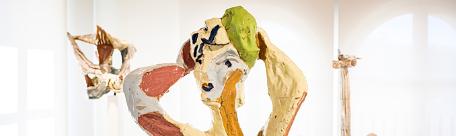
In addition to being a lofty testament to Umbrian medieval and modern art, the Church of San Francesco today also hosts numerous exhibitions of contemporary art and photography, which blend magnificently with the church’s setting.
… and to the picture gallery
On the first floor of the convent adjoining the church, the municipal picture gallery has been housed since 1995. It contains paintings, sculptures, silverware and liturgical vestments of great artistic value, originating from the church of the same name and from other churches in the surrounding area.
Among the works on display, special mention should be made of the processional banner by Bartolomeo Caporali depicting the Madonna of Mercy, created in 1482 against the plague that was raging in the area; the Annunciation with Saints Fedele and Lazarus, a panel painted in 1532 by Tommaso di Arcangelo known as “il Papacello” (from the school of Luca Signorelli) for the church of San Fedele; a beautiful 13th-century wooden group representing the Deposition from the Cross, formerly in the parish church of San Gregorio Magno outside the walls; two interesting family trees from the early 18th century depicting the genealogy of the Fortebracci family. There is also a small but precious section dedicated to liturgical vestments.
The new archaeological section houses the finds from the recently explored Roman villa near Santa Maria di Sette, dating to the 2nd century AD: fragments of roof tiles, vases and amphorae, pieces of black ceramic tableware, a silver coin, and parts of a marble mosaic. This was probably a villa of considerable size and importance, which belonged to a wealthy and distinguished figure of the time.
Currently closed is the Ethnographic Museum “Il Tamburo Parlante” (“The Talking Drum”), an interesting collection curated by anthropologist Enrico Castelli, whose distinctive feature lies in presenting the individual ethnic groups not through the objects once belonging to them, but according to the characteristic ecosystems of the African region: forest, savannah, coast and the Great Lakes region.
Finally, the ground-floor rooms of the ancient convent house the MuMO – Museum of San Francesco of Montone, a multimedia museum itinerary to discover the places and events linked to the famous condottiero.