The exterior: a composite and imposing appearance
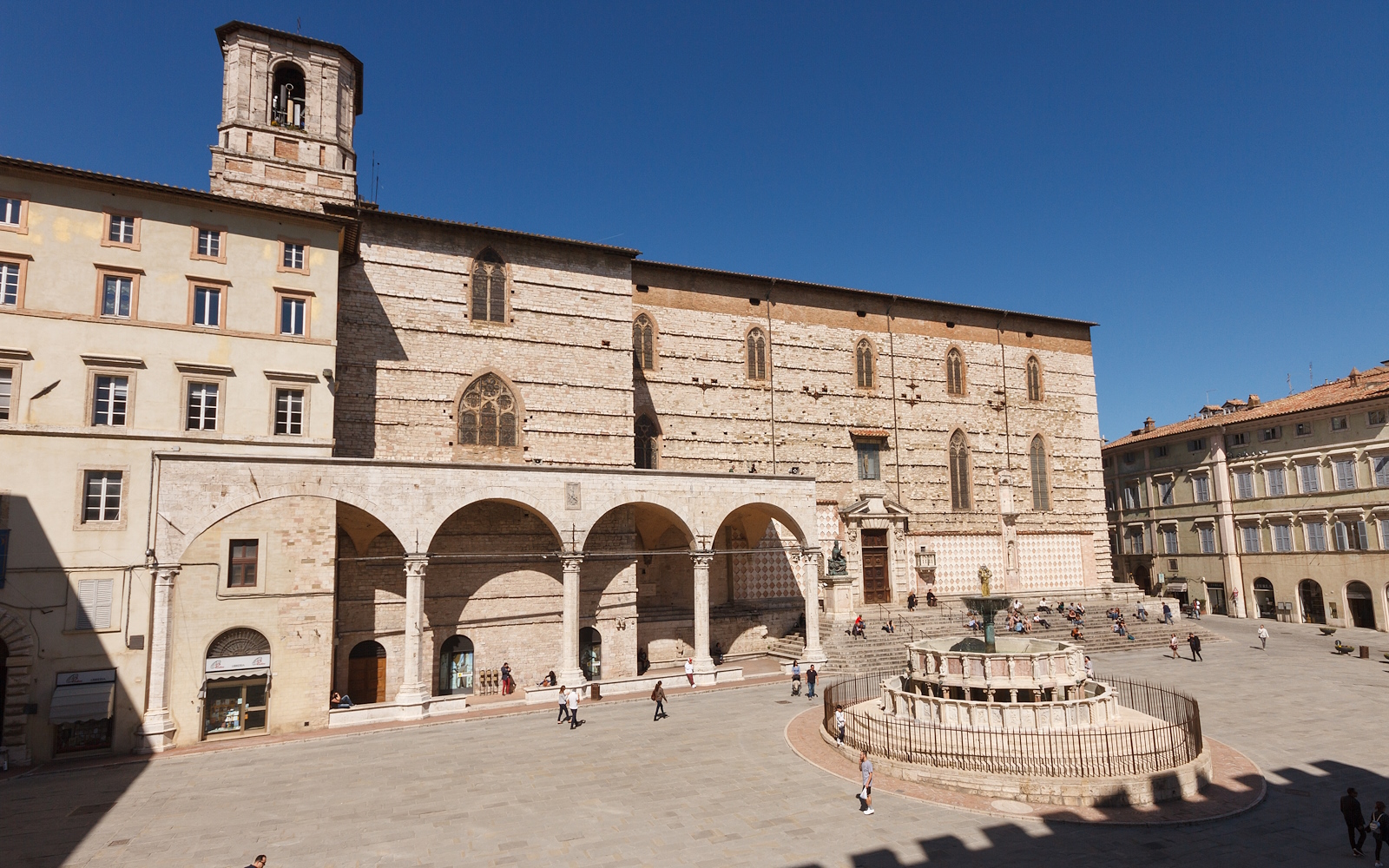
The side overlooking Piazza IV Novembre reveals the layering of different building phases. Its unfinished marble cladding, decorated with white and pink quatrefoils only up to a certain height, gives it a rather rustic appearance. On the left stands the loggia commissioned in 1423 by Braccio Fortebraccio da Montone, which was once connected to his residence, now lost.
The portal facing the square was designed by Galeazzo Alessi in 1529. Above it is a glass-protected niche housing a wooden crucifix by Polidoro Ciburri, which was displayed on the churchyard after Pope Paul III excommunicated the city during the Salt War (1540). On this same side, there is also a small 15th-century pulpit built with reused materials, traditionally linked to Saint Bernardino of Siena, who preached several times in the city between 1425 and 1427. Another niche once held a bronze statue of Pope Paul II, later melted down during the Napoleonic period. Also noteworthy is the bronze statue of Pope Julius III, a 16th-century work by Vincenzo Danti. The façade, much less monumental than the side facing Piazza IV Novembre, opens onto Piazza Danti and features a lively Baroque portal designed by Pietro Carattoli in 1729.
To the left of the Logge di Braccio is a large entrance leading to one of the two cloisters of San Lorenzo. Built in the 18th century, it consists of a porticoed courtyard with two superimposed orders of pillars. On one side of the courtyard stands the Museum of the Chapter of San Lorenzo. The second cloister, dating back to the 15th century, is made up of three loggias on different levels, supported by reused granite columns of much earlier origin. It was created through the expansion of the so-called canoniche (rectories), the residential units used by priests and clerics of the complex, and still today it houses private dwellings.
Beneath the cathedral lie ancient structures that form part of Underground Perugia, an archaeological itinerary that reveals Etruscan, Roman and medieval remains. It can be accessed from the adjacent Isola di San Lorenzo complex.
The interior: a spacious layout, with clever tricks to make it appear even larger
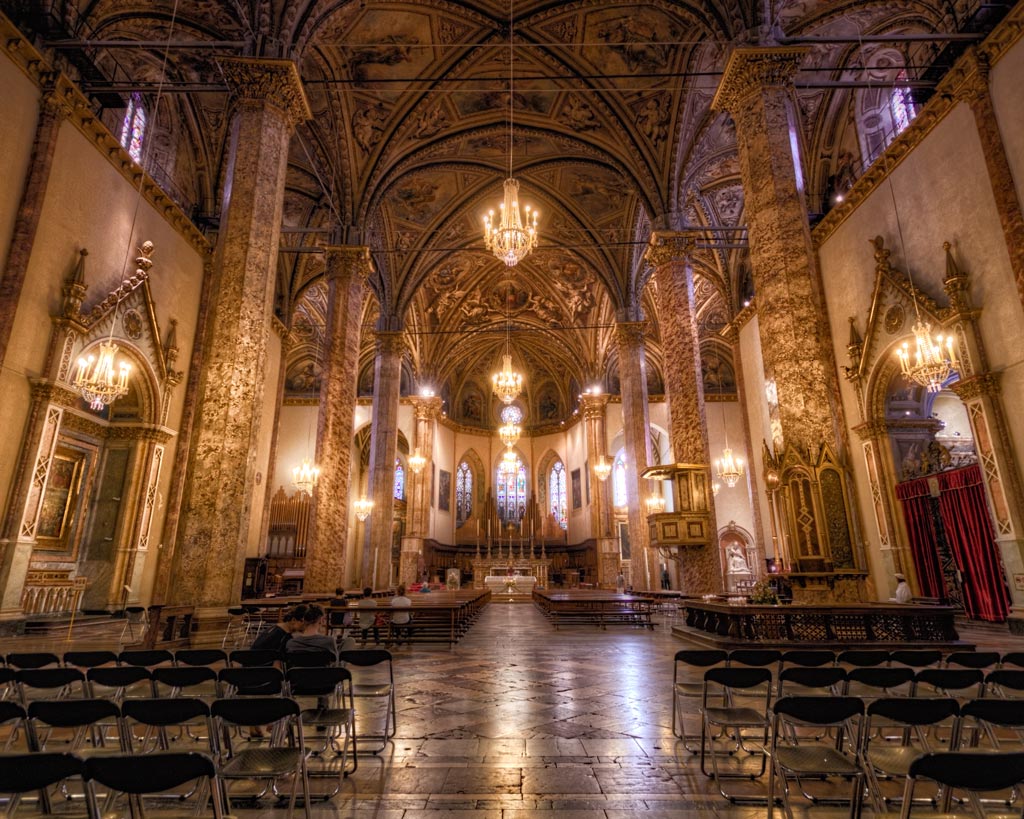
The interior of the cathedral consists of three naves, each with five bays, separated by massive pillars and completed by a crossing, transept arms and five apsidal chapels. The space appears wide and expansive, thanks both to its Hallenkirche structure, with naves of equal height (around 25 metres), and to architectural devices such as the slightly sloping floor between the entrance and the apse area, as well as the proportion between the naves, where the central one measures two and a half times the width of the side aisles.
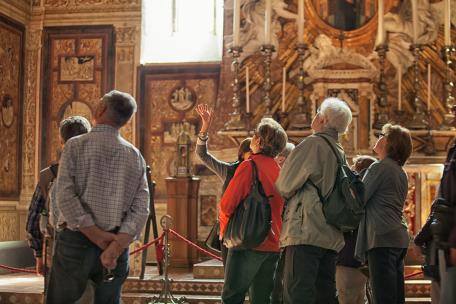
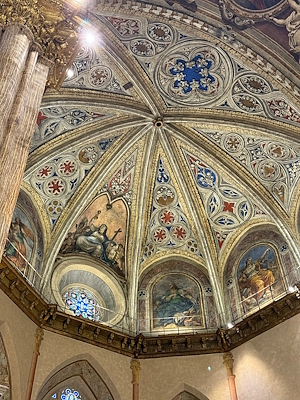
The interior is sumptuously decorated, in keeping with 18th-century taste. From this period date the paintings, stuccoes, gilding and marble mouldings, whether real or painted, as well as the panels and medallions that entirely cover the vaults. The earlier 15th-century decoration was replaced by an extensive artistic campaign that brought together some of the leading local painters of the 18th century, including Francesco Appiani, Valentino Carattoli, Carlo Spiridione Mariotti and Vincenzo Monotti.
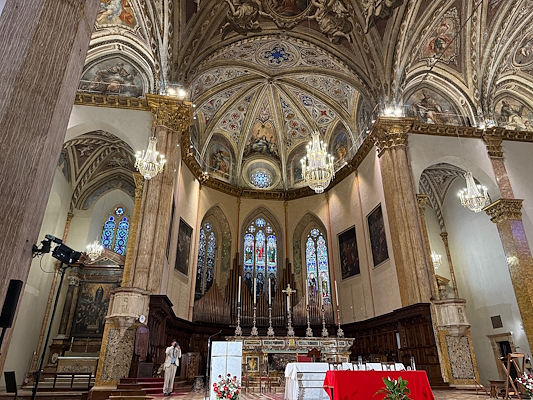
The high altar, made of polychrome marble, was designed by Carlo Murena in 1762. In the right aisle, behind a late 15th-century wrought-iron gate, lies the Chapel of Saint Bernardino of Siena, which houses the beautiful painting Deposition from the Cross by Federico Barocci (1567–1569), widely regarded as the cathedral’s finest artwork. Facing the side entrance, on the third column of the nave, is the highly venerated fresco of the Madonna delle Grazie, attributed to Giannicola di Paolo.
In the left aisle, notable works include the remains of the Pietà Altarpiece, sculpted by Agostino di Antonio di Duccioin 1474, and the Altar of the Gonfalone, which displays the banner painted by Berto di Giovanni in 1526 during a severe plague. This artwork represents one of the most complete iconographic depictions of Perugia before the construction of the Rocca Paolina and the subsequent urban transformations.
On the counter-façade wall hangs a large canvas by Giovanni Antonio Scaramuccia, depicting the Virgin surrounded by the city’s patron saints Lawrence, Constantius and Herculanus together with Saints Augustine, Dominic and Francis (1616). Set against the same wall, to the right of the entrance, is the sarcophagus of Bishop Giovanni Andrea Baglioni, one of the main figures behind the cathedral’s reconstruction, sculpted by Urbano da Cortona in 1451. The rose window contains a stained glass representation of the Martyrdom of Saint Lawrence, created by Lodovico Caselli in 1919.
Once kept in the church, near the Oratory of Sant’Onofrio in the right transept, was the splendid altarpiece of the Madonna Enthroned with Saints John the Baptist, Onuphrius, Lawrence and Herculanus, painted by Luca Signorelli and now housed in the Museum of the Chapter.
An elegant 15th-century portal to the right of the transept leads into the sacristy, which preserves one of Perugia’s finest Mannerist fresco cycles. From the dim light of the heptagonal apse, the colours of the stained glass windows and the wooden choir stalls, carved in 1486 by Giuliano da Maiano and Domenico del Tasso, stand out beautifully.
Within the church, in the Chapel of the Holy Ring, the venerated relic of the Virgin’s wedding ring is kept. It was taken from the inhabitants of Chiusi in 1473. The ring, enclosed in a precious reliquary and locked inside a safe with seven locks, is placed eight metres above ground inside a niche protected by gilded ironwork and four additional keys. The Holy Ring is displayed only twice a year, between 29 and 30 July and on the second-to-last Sunday of January, during the Feast of the Marriage of the Virgin, when wedding rings are blessed. On the chapel’s altar stands Jean-Baptiste Wicar’spainting The Marriage of the Virgin (1825), which replaced the earlier work of the same subject by Pietro Perugino, looted during the Napoleonic spoliations and now kept at the Musée des Beaux-Arts in Caen.








.jpg/e9571273-0e35-1ff2-0713-76c7fd4e3cc5?width=456)



.jpeg/0d7d918e-eddd-ed4c-9da2-23a6917261f0?width=780)
.jpg/57eda7af-f14d-d05d-f11c-d1cdb56c5f9f?width=780)
.jpeg/8031dd9b-06c7-4ac1-a77b-86e1376416b6?width=780)