

Titolo: Octagonal church of Santa Maria della Reggia - Umbertide

Octagonal church of Santa Maria della Reggia - Umbertide

The Miracle that gave origin to the sanctuary


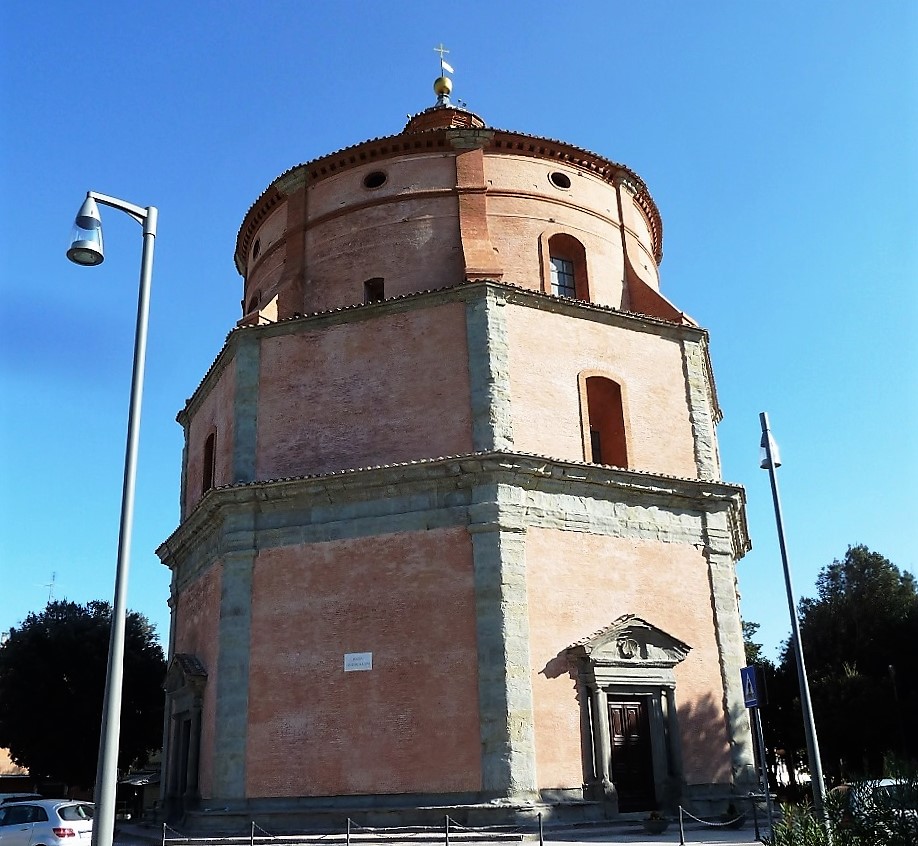
The genesis of this church is linked to an extraordinary event. On September 14, 1556, near the Reggia stream, the ruins of a chapel containing a fresco of the Madonna were found. Tradition recounts that Orlando Vibi, a citizen of Perugia, went there with his wife and his daughter, who had been crippled from birth. Left praying before the image, the young girl heard the voice of the Virgin and was instantly healed. This prodigy sparked a wave of popular devotion, with offerings substantial enough to justify the construction of a majestic temple dedicated to the Mother of Christ.


A Centuries-long Construction Site: the architecture and building challenges


Begun in 1559 on an ambitious design by Galeazzo Alessi and Giulio Danti, the construction was an work of tenacity. The building site, continued by Bino Sozi, Mariotto da Cortona, Rutílio and completed by Bernardino Sermigni only in 1663, was marked by setbacks and second thoughts. A structural defect necessitated the demolition and reconstruction of the dome between 1614 and 1647, while economic difficulties slowed down the works, which overall cost the enormous sum of 40,000 scudi. The result is a masterpiece of geometry: an octagonal exterior in brick enclosing a circular interior, where sixteen paired columns, 9.60 meters high and of Tuscan order, support detached from the wall the imposing 40-meter high dome.

The Artistic and Devotional Heart of the building


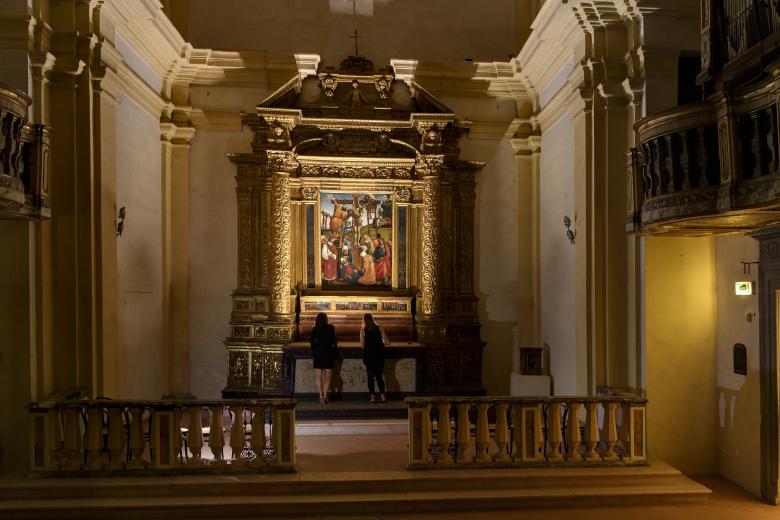
Beyond its architecture, the Collegiate Church is a rich container of art. The gaze is immediately captured by the ring of columns and the four large canvases adorning the drum of the dome:

  • Above the main altar, a Virgin in Glory with Saints Mary Magdalene, John the Baptist, John the Evangelist, Andrew, Francis and Apollonia, attributed to a Roman school of the 16th century.

  • Above the organ tribune, the Transfiguration (sometimes referred to as Ascension), a work signed and dated 1578 by Niccolò Circignani, known as Il Pomarancio.

  • Above the Altar of the Rosary, the Blessed Virgin of Loreto with Saints Andrea Avellino and Ubaldo, by G. Alaboyna (1749).

  • Above the Altar of Saint Joseph, a Regular Cleric Saint with Christ presenting him the cross, also by G. Alaboyna (1749).

    Among the most valuable furnishings stand out:


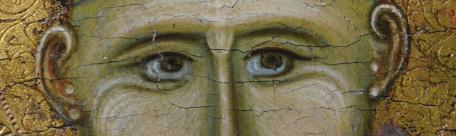
  • The icon of the Madonna: a sumptuous stucco pinnacle (1725) with drapery and angels framing the miraculous 15th-century fresco.
  • Altar of the Blessed Sacrament: a rich work of gilded wood carving by Peter Kraas (1680), featuring the figure of God the Father by Luigi Scaramuccia, a precious Florentine tabernacle from the 16th century and a 19th-century wooden Crucifix.
  • Baptismal font: a most valuable white marble basin from the 16th century.
  • Altar of the Rosary: enhanced by fifteen panels painted on copper depicting the Mysteries of the Rosary (17th century).
  • • Altar of Saint Joseph: which houses a precious statue from the Florentine school of the 16th century.


From Consecration to today, the evolution of a Title

The church, consecrated only in 1751, assumed the title of Collegiate Church in 1804, when the chapter of canons previously based in the church of San Giovanni was transferred there. The 20th century brought the devastation of a bombing in 1944, which destroyed the sacristy and the archive, causing an irreparable loss of historical documents. Today, after a radical restoration in the 1990s, the building is the seat of the Parish of San Giovanni Battista and awaits new interventions for the full conservation of its artistic heritage.

Explore the surroundings
Main attractions in the vicinity