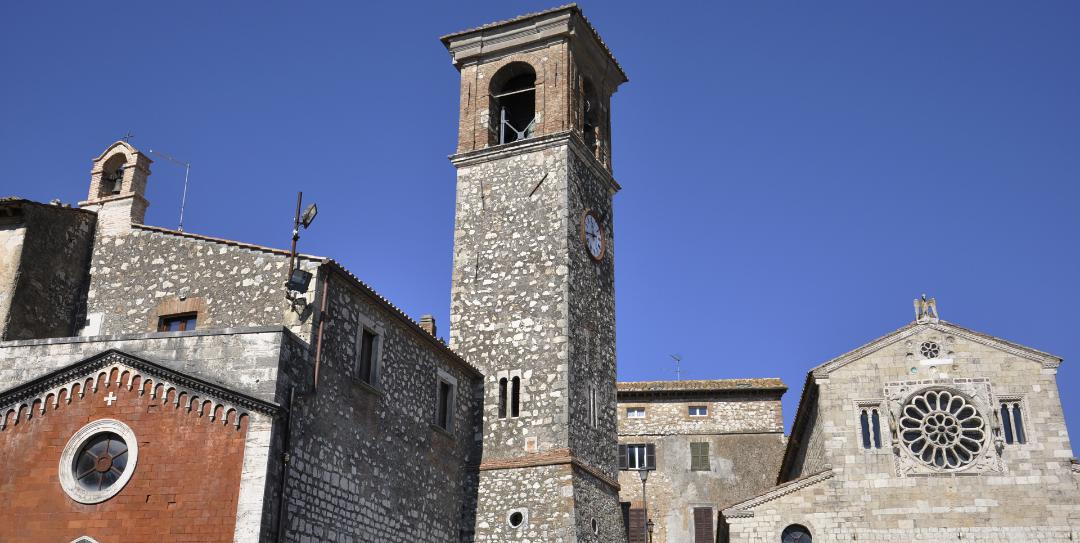
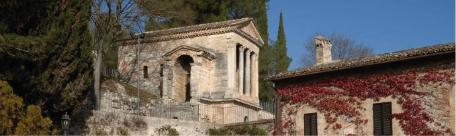

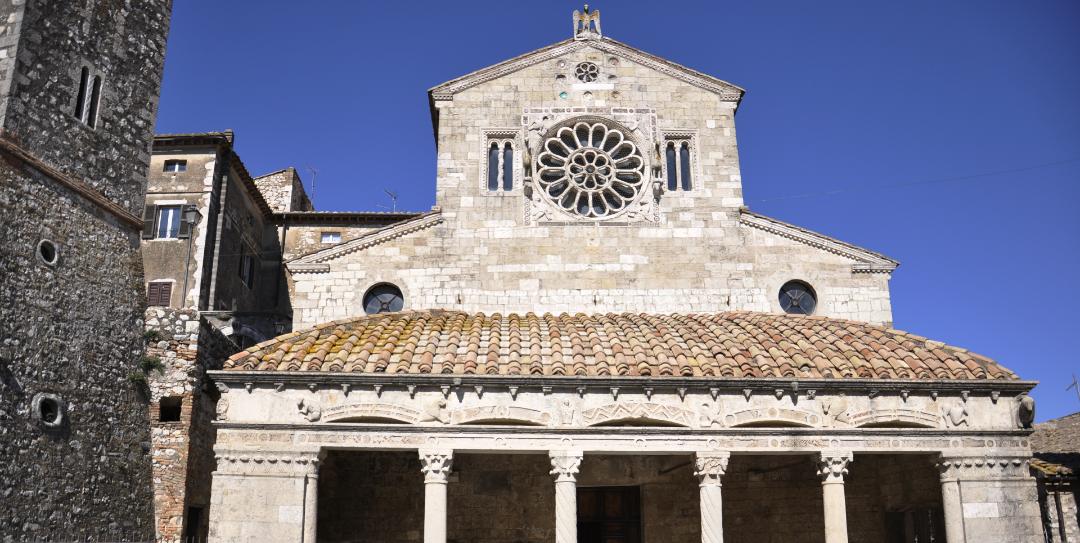
Stone façade of the Church of Santa Maria Assunta with central rose window and columned portico under blue sky.

Church of Santa Maria Assunta – Lugnano in Teverina

The Church of Santa Maria Assunta, also known as the Collegiate Church of Santa Maria Assunta, stands in the heart of the historic centre of Lugnano in Teverina, overlooking the ancient medieval square, the Platea di Santa Maria.

This gem of Umbrian Romanesque architecture is the spiritual and architectural focal point of the Terni village: its imposing portico immediately strikes the eye with its harmonious proportions and its rich symbolism carved into the stone.

Over the centuries, the building has undergone numerous alterations and restoration works, yet it has largely preserved its original appearance, particularly in the apse area and the splendid façade.

History of the building: from Desiderius to the heart of the community

Built between the 11th and 12th centuries on the remains of a pre-existing church commissioned by the Lombard king Desiderius, the first documented mention of the church dates to 1230, as evidenced by an inscription featuring an article of the 1508 Statute, now embedded in the portico.

In the 14th century, the building underwent significant modifications, but it was in the 16th century, with its elevation to Collegiate status, that it took on its final form, enriched by a chapter of canons. More than just a place of worship, it also served as a civic centre: public assemblies and oaths were held among its naves, reflecting the close intertwining of the sacred and the communal.

The Romanesque façade: symbols carved in stone

The imposing Romanesque façade, tripartite and crowned by a tympanum, is a compendium of theological symbols and masterful craftsmanship. The portico, supported by four columns and pilasters, features five lowered arches, each adorned with the symbols of the Evangelists.

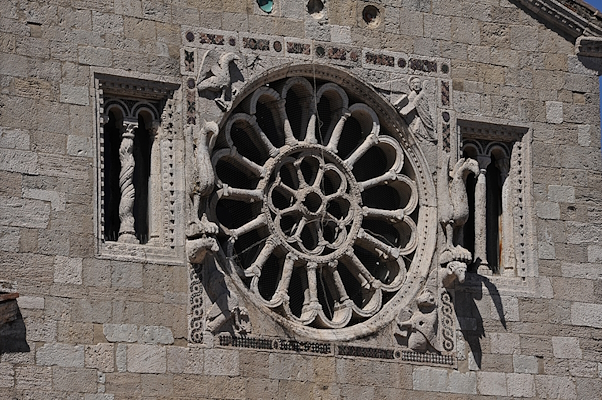
At the centre, arose window with two orders of small columns stands out within a mosaic square, flanked by heraldic griffins and ram heads. The four Evangelists’ symbols are placed at the corners. To the sides are pierced double-lancet windows. Above, a second rose window framed with porcelain tiles leads the gaze to the pinnacle of the composition: an eagle holding a sacrificial lamb, a powerful Christological allegory. To the left, the 16th-century bell tower keeps watch over the passing of time.
The interior: architecture and spirituality

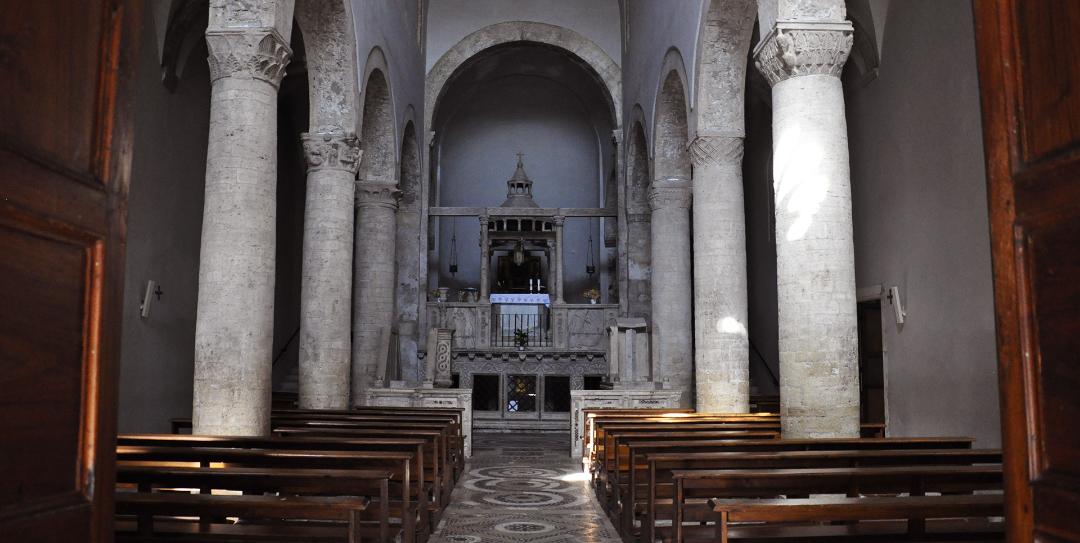
Beyond the threshold, the space opens into three naves: the central one with a barrel vault, the lateral ones with groin vaults. The columns, with capitals decorated with stylised foliage, mythical animals and geometric motifs, are a showcase of Romanesque art.

The raised presbytery, accessible via two staircases, houses an elegant ciborium and the schola cantorum. Below it, the crypt offers a place for quiet reflection. The 20th-century restoration works brought to light medieval architectural fragments, restoring the church’s austere 13th-century character.

Stolen and recovered treasures

  • A Giottesque fresco of the Crucifixion, stolen in 2005, once adorned the right chapel.
  • On the altar, The Beheading of Saint John the Baptist (1571) by Livio Agresti is paired with a Saint Jerome attributed to Leandro Bassano.

A mosaic of stone: the “historical forgery” imitating Cosmatesque style

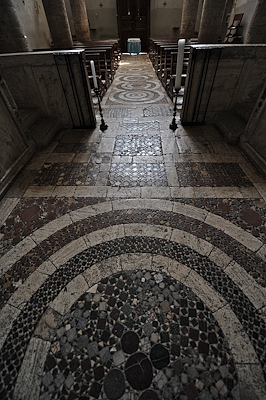
The floor of the Collegiate Church is an intriguing “historical forgery” created in the 14th century in imitation of the Cosmatesque style, although it is not the work of the famous Roman Cosmati workshops. Despite several renovations, the irregular geometries—composed of fragments of polychrome marble and spolia—form a striking mosaic carpet, demonstrating how the Middle Ages relished reinventing the past.

Symbols beneath your feet

  • At the entrance, a quincunx (central circle with four discs at the corners of a square) marks the beginning of the sacred path, followed by two guilloches (circular braids of three discs), separated by an asymmetric quincunx.
  • In the presbytery, a large central wheel dominates the layout, framed by geometric motifs imitating Roman Cosmatesque mosaics.
  • The second guilloche, made with repurposed elements, reveals the “neo-medieval” nature of the reconstruction – a product of a late 14th-century architectural trend that freely celebrated artistic heritage of the 12th

The crypt, hidden heart of the building

Through two portals decorated with carved crosses, one enters a space of austere beauty: columns with Corinthian capitals support travertine architraves, dividing the crypt into small naves.

Inside, a 16th-century alabaster is preserved – an object of deep popular devotion – is preserved. According to tradition, the crucifix was brought from Palestine by a Franciscan friar. It was later gifted to a cardinal living in Rome who, on his deathbed, bequeathed it to the Benedictine nuns of Lugnano in Teverina. After the nuns left the town, the Most Holy Crucifix was transferred to the Collegiate Church, where it is still venerated today and considered miraculous.

Heavenly music

Two pipe organs testify to centuries of musical tradition:

  • A Tyrolean Werle organ from 1756, located in the right nave.
  • A modern instrument by Rino Pinchi (1950s), in the left transept.
Explore the surroundings
Main attractions in the vicinity