Jacopo Siculo’s Masterpiece: The Passing of the Virgin
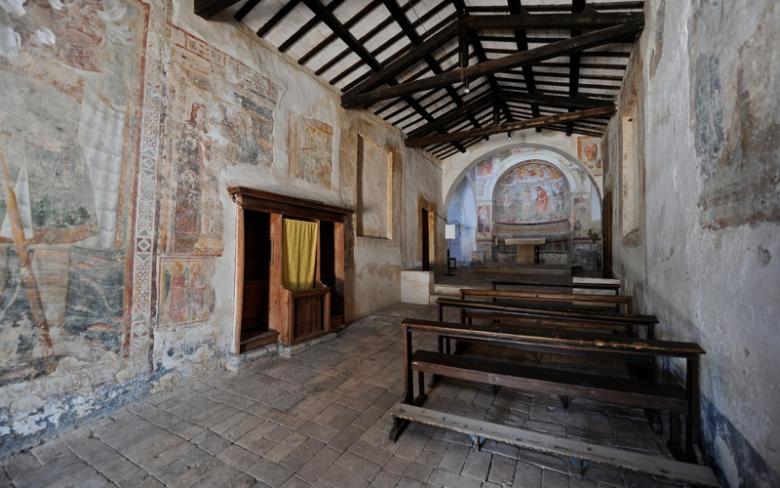
At the back of the building, and particularly in the apsidal basin, one can admire the fresco cycle by Jacopo Siculo (Giacomo Santoro da Giuliana), executed in 1536 on commission from the local community and entirely dedicated to the Virgin Mary. The work of an artist trained in Raphael’s school, and son-in-law of the renowned Giovanni di Pietro known as Lo Spagna, it represents a fine example of 16th-century painting.
The main work, The Passing of the Virgin (or Dormition), stands out for its distinctive features. The artist illustrates an episode from the Golden Legend: while the Apostles carry Mary’s bier, an angel drives away some Jews attempting to overturn it and profane it. The scene is rich in expressive details: the intense faces of the Apostles and of Saint John the Baptist, the natural landscape with the castle of Vallo in the background, and above all the figure of Saint Thomas. He is portrayed slightly apart, behind the group, recognisable by his light-blue tunic, red cloak, and the girdle he holds in his hand.
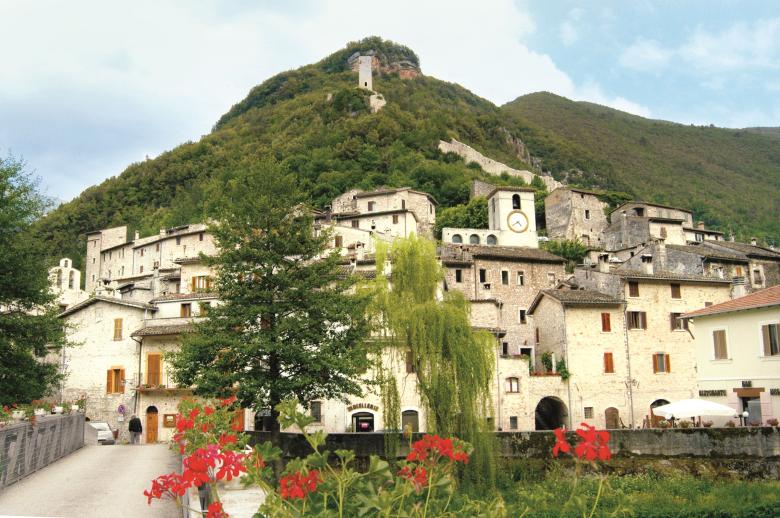
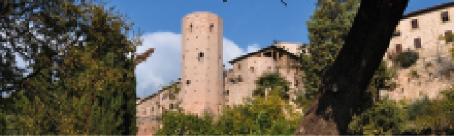
The depiction of the castle of Vallo di Nera also carries strong historical and symbolic significance. After the revolt of 1522, during which several towns rose up against Spoleto under the leadership of Petrone da Vallo, the castle was almost completely destroyed. The image painted in the following decade shows its walls, towers, and houses already rebuilt. It is likely that the inhabitants of Vallo di Nera, wishing to renew their political and religious alliance with Spoleto, commissioned Jacopo Siculo to create a fresco inspired by the Stories of the Virgin painted by Filippo Lippi in the Cathedral of Spoleto.
Completing the cycle are, in the upper part of the apsidal basin, the Coronation of the Virgin, and on the front of the arch, the Annunciation.
Other Artistic Testimonies
On either side of the apse, the imposing life-size figures of Saint Sebastian and Saint Roch watch over the nave. A Christ in Pity with the Symbols of the Passion is also attributed to Jacopo Siculo.
The church’s artistic legacy extends further: along the side walls runs the fourteen Stations of the Cross, dated 1749, while at the entrance are a 16th-century stone baptismal font and holy water stoup. Numerous other 16th-century paintings and relics, dating from 1722 to 1814, further enrich the building’s artistic heritage.









.jpg/e9571273-0e35-1ff2-0713-76c7fd4e3cc5?width=456)