





Papigno and the Art of Corot
The Medieval Structure of the Fortified Settlement
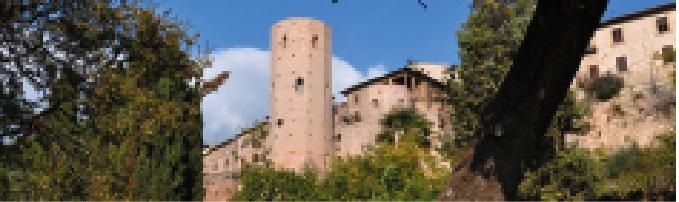
Near Terni, perched on an isolated hill, the castle of Papigno overlooks the Valnerina Valley and the ancient Via Curia—two important routes of the former Duchy of Spoleto. Built in the early Middle Ages for defensive and lookout purposes, the fortified village is a fascinating blend of history and architecture, with its network of walls, towers, and evocative passageways.
Climbing the access ramp, visitors reach the ancient western gate, renovated in the 16th century with an elegant travertine portal. Here, architectural details such as the extradosed arch and iron hinges reveal centuries of passage and transformation.
At the northern end of the village, two quadrangular towers still stand: the western one offers a splendid view over the Via Curia and the valley below, while the eastern one, partially hidden by vegetation, retains its imposing presence. On the southeastern side, the old defensive wall intertwines with more recent buildings, testifying to the ongoing evolution of the village.
The main entrance to the village was through the southern gate, once framed by two massive semicircular towers. Today, a modern plaster layer conceals some of the original details, but the solid medieval structure is still visible.
Papigno was first mentioned in 1220, when the Arroni family pledged it to the city of Terni. After failing to reclaim it, the village was purchased in 1225 by the Municipality of Terni and has since shared the fate of the Umbrian city, later falling under Papal control.
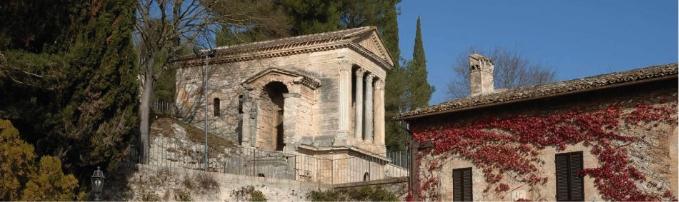
The village's layout follows the typical pattern of Umbrian medieval castles: rows of houses arranged in parallel lines and a defensive system centered around a main tower, now incorporated into the Church of Santa Maria. Recently restored, the church is built from limestone and a local variety of travertine known as sponga—as locals call the porous travertine—with finely cut corner blocks.
Walking along the castle perimeter, one can still see medieval loopholes designed for defense. On the southern side, brick arches and roughly hewn limestone blocks create a fascinating interplay of shapes and materials, reflecting the village’s many construction phases.
Curiosity: The Timeless Art of the Landscape
Surrounded by ancient woods and archaeological treasures, Papigno became one of the favorite destinations for plein air painters, a group of European artists active between the late 18th and early 19th centuries who, during their Grand Tour in Umbria, stopped in the Terni area to paint the region’s wonders from life. One of the most renowned among them was Jean-Baptiste Camille Corot, one of the greatest 19th-century painters, who visited Papigno during his first journey to Italy between July and September 1826. He stayed at the Graziani family villa and spent his time painting en plein air the stunning landscapes of the Terni and Narni valleys.
From Papigno, he ventured into the surrounding areas, producing evocative works of the Marmore Falls, Lake Piediluco, the Nera and Velino rivers, and the ruins of the Augustus Bridge in Narni. So enchanted was he by Papigno that he created eight landscape paintings and three sketches on site—now held in prestigious museums and international private collections.
To celebrate his legacy, two themed itineraries were developed: one within the village of Papigno and another broader route covering the surrounding area. Along the route, informative signs display reproductions of his works at the exact locations where they were painted, along with biographical information about the artist.
The Corot itineraries are part of the Museo Diffuso dei Plenaristi, an open-air museum tracing the steps of plein air painters in the Nera Valley during the 18th and 19th centuries.
From Painting to Cinema: The Papigno Studios
In 1997, near the village, the Umbria Studios were established by Roberto Benigni and Nicoletta Braschi, who filmed Life is Beautiful here — the beloved movie that won three Academy Awards and the Grand Prix of the Jury at Cannes. The project transformed an abandoned industrial complex into two sound stages and a special effects studio. Unfortunately, the studios—once open to visitors—have been abandoned for several years. However, a revitalization and reopening plan, supported by the Municipality of Terni, is currently underway, and we hope it will come to life in the near future.