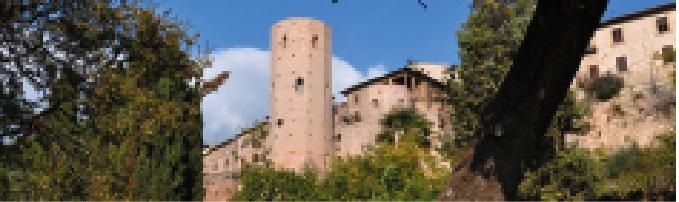




Rocca di Aries in Montone, majestic medieval fortress rising above the vegetation under a clear sky.

A long history of ambushes, traps, and medieval lords: the Rocca di Aries

Imposing and majestic, surrounded by lush vegetation, the Rocca di Aries (fortress of Aries) rises over a vast territory that once served as an important communication route between the Tiber Valley and the Adriatic Sea. It is possible that it was built on the remains of an ancient Roman fortification, since it has preserved its Latin name, Aries (meaning "ram" or "tup" in Italian).

The current structure is largely the work of the Fortebracci family, lords of that land. Starting in 1376, on the remains of a pre-existing fortress that had defended the early population since the year 1000, Oddo III Fortebracci—father of the more famous Braccio—, rebuilt the ancient fortress, making it practically impregnable. Over time, the fortress served as a fortified garrison defending the nearby village of Montone, which even derived its own name from it, adopting the Italian translation. It was only in the sixteenth century that the fortress became independent from the Umbrian town. Braccio Fortebraccio, lord of Montone and, from 1416, also ruler of Perugia and much of Umbria, had a mighty fortress built in the upper part of Montone, which replaced this more ancient one in its defensive and residential function.

The Rocca of Montone was almost completely destroyed in 1478 by the papal troops of Pope Sixtus IV. Only the keep and some parts later incorporated into the convent of Santa Caterina remain. The fortress of Aries, instead, has preserved its original structure, despite undergoing several modifications to adapt it for residential use. It is said that Nicoletta da Varano, Braccio Fortebraccio’s second wife (married in 1420 after the death of his first wife, Elisabetta Armanni of Perugia), particularly enjoyed staying there. The fortress endured numerous sieges over the centuries, the most famous being in 1502 by Cesare Borgia. Like all castles, it has inspired legends and tales, such as the existence of a trapdoor equipped with blades beneath the ballroom, into which unwelcome guests were hurled.

In the sixteenth century, it became a fief of the Bentivoglio family. Later records date back to 1596, when the fortress was attacked by six hundred bandits who at the time were ravaging the Gubbio area, causing extensive damage to the defensive structure.

The Bentivoglio family later sold the fortress for 15,000 Roman scudi to Count Giambattista Cantalmaggi. From him, by hereditary rights, it passed to the Della Porta family. In the 1980s, the fortress still belonged to this family when it was purchased by the Umbria Region and underwent a meticulous conservative restoration.

It has a rectangular plan, with a semicircular tower on one side, and has retained its massive and imposing appearance despite the various interventions it has undergone over the centuries.

It is currently closed to the public, except on special occasions, but the view it offers and the charm of its long history make it well worth the visit!

Explore the surroundings
Main attractions in the vicinity