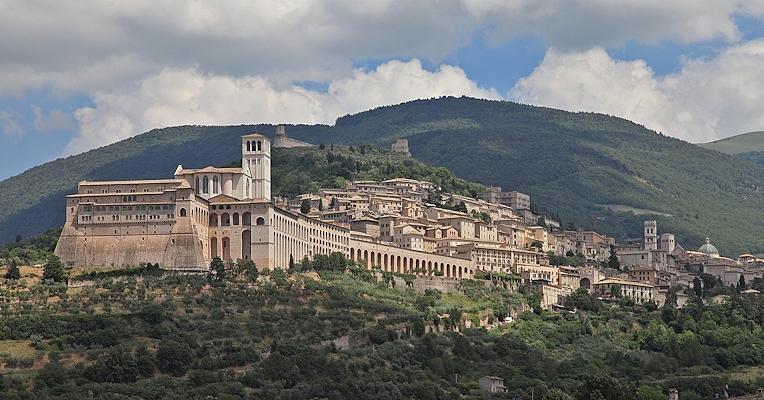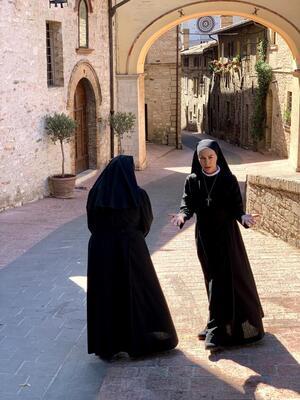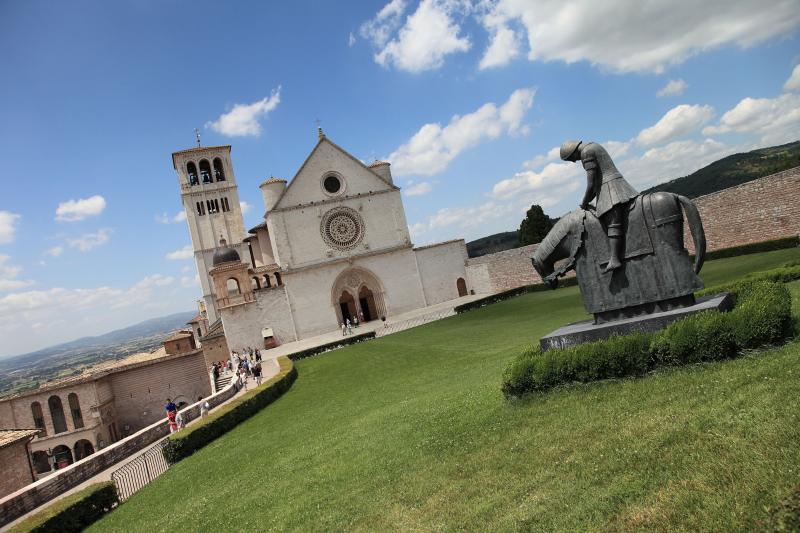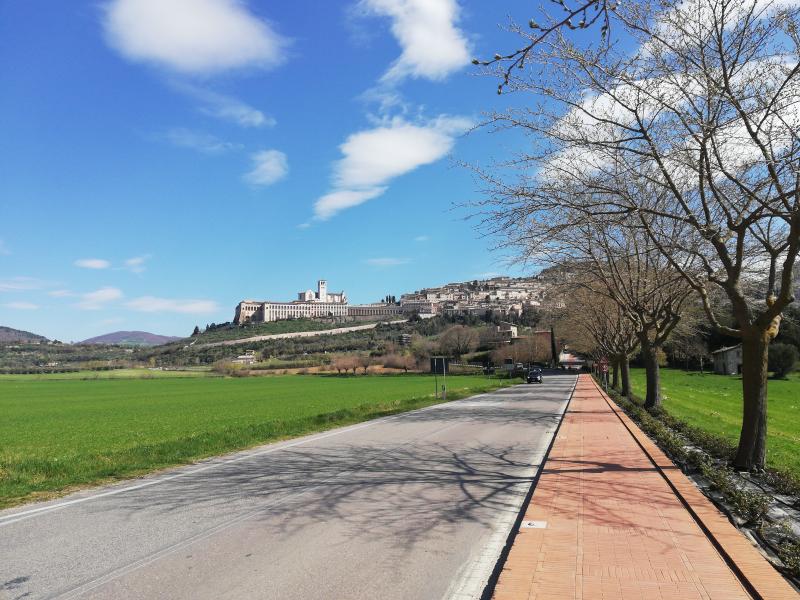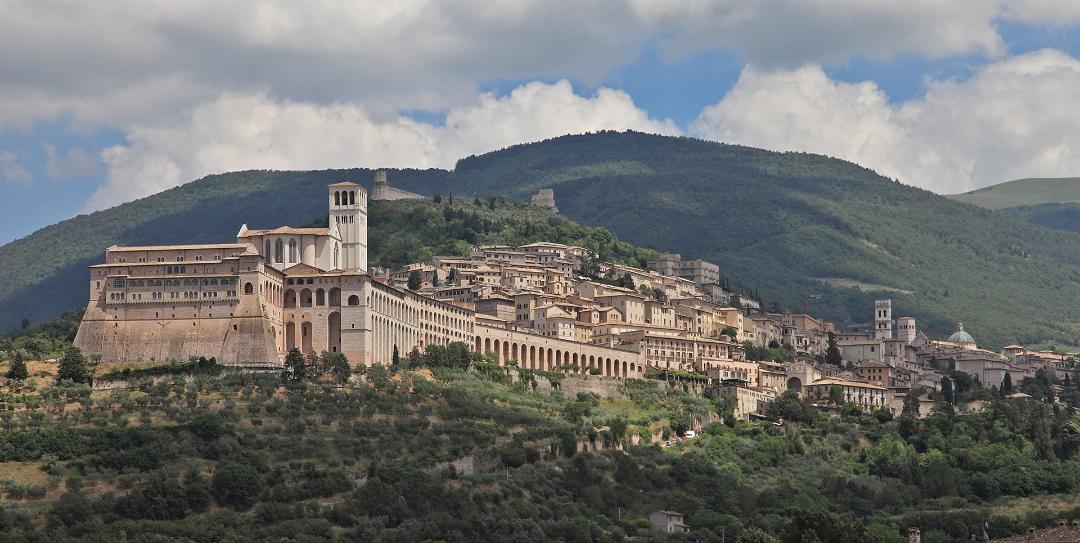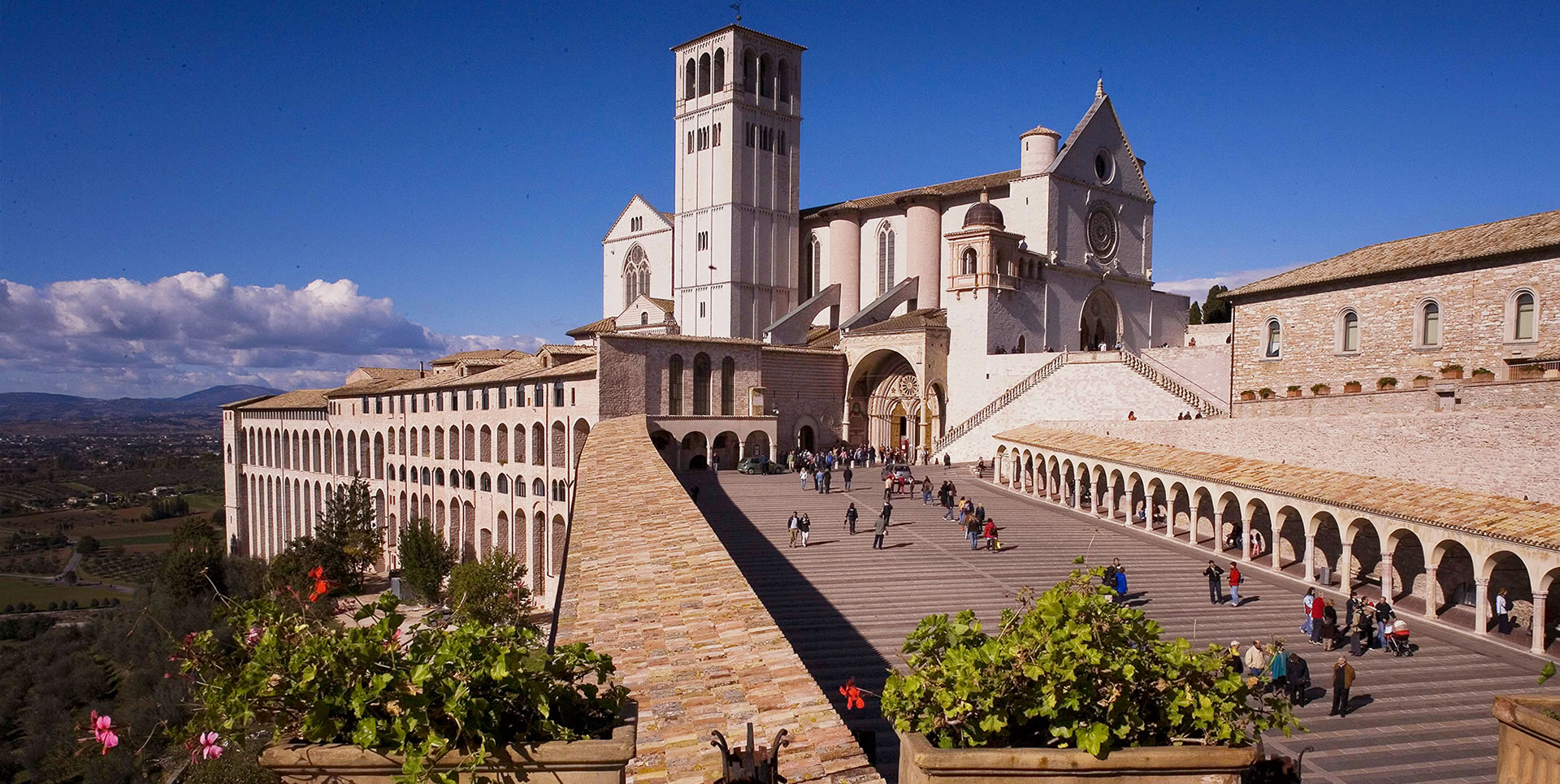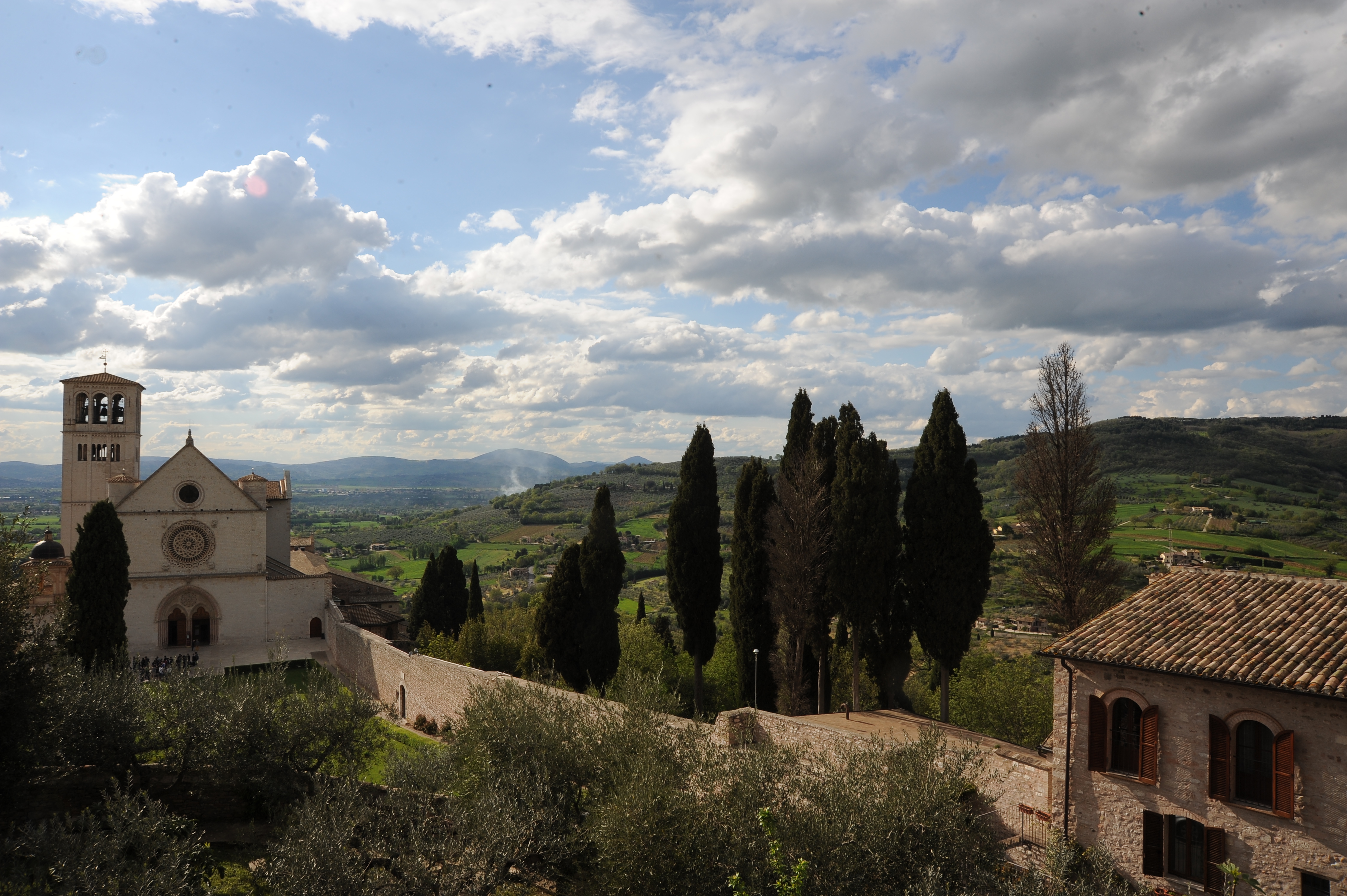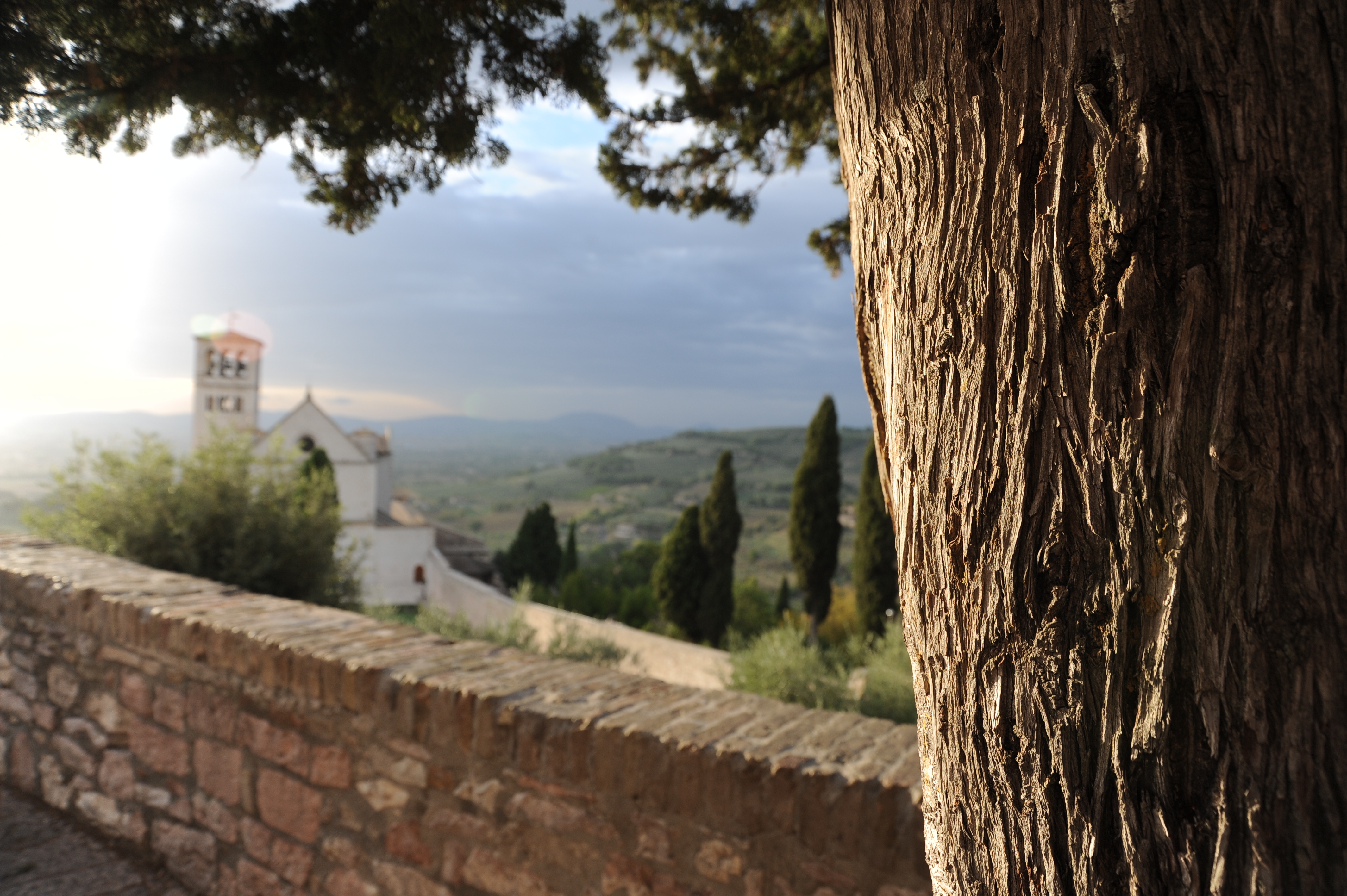



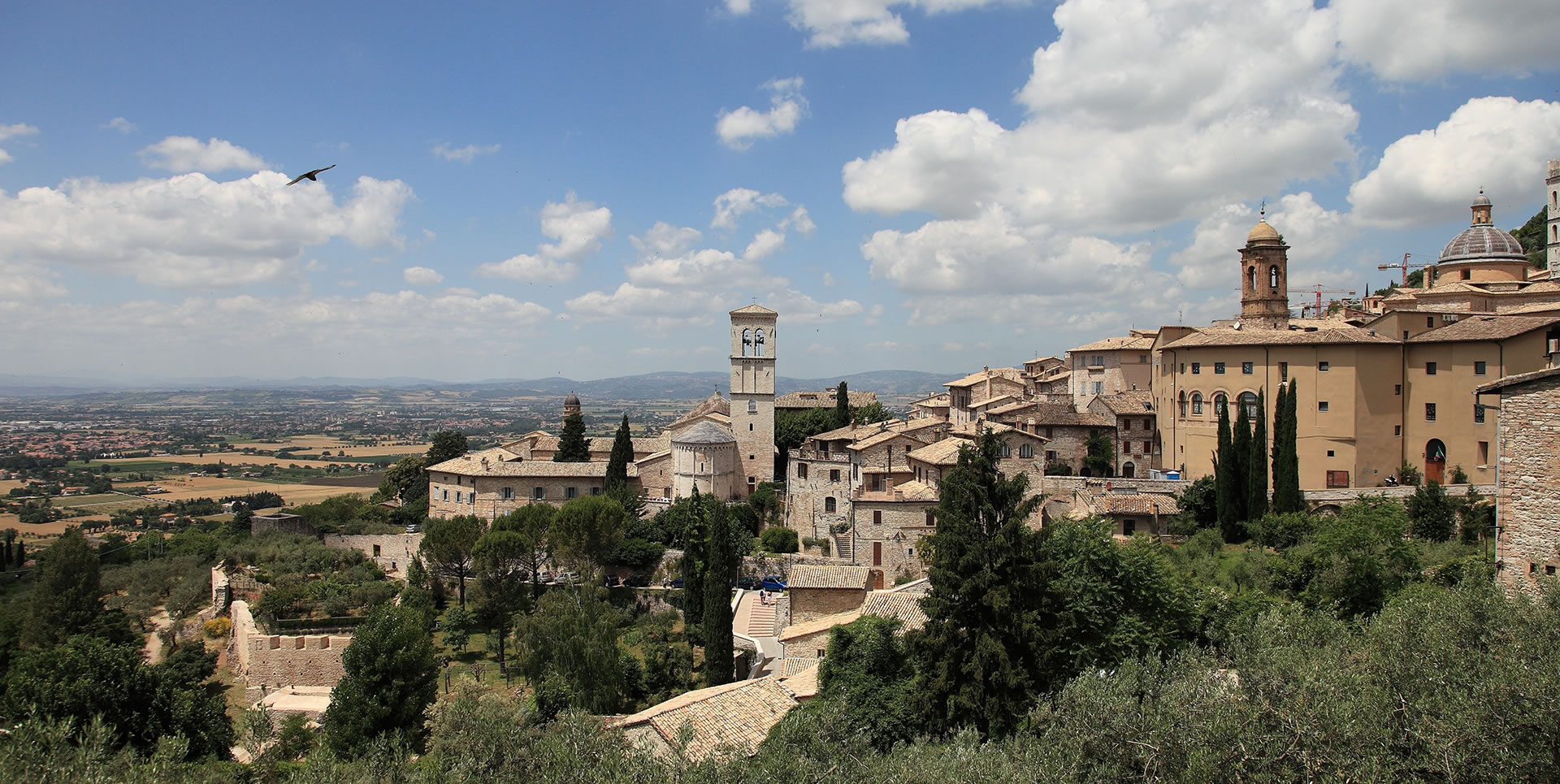
Located in the central-eastern part of Umbria, Assisi overlooks the plain crossed by the Topino and Chiascio rivers. Built with the typical “pink stone” of Mount Subasio on which it rests, the city of Saint Francis boasts a millenary history with important Roman, medieval, and Renaissance remains. The Basilica of Saint Francis, with its cycle of frescoes depicting the saint’s life painted by Giotto, has left a profound mark on art and spirituality in Italy and throughout the world.
Historical Notes
The oldest traces of human presence in the territory of Assisi date back to the Neolithic period. Later, between the 9th and 6th centuries BC, the Umbrians established the first village here, and numerous archaeological finds suggest the existence of relations, mainly commercial, with neighboring populations such as the Etruscans.
With the Battle of Sentinum in 295 BC, the Romans imposed their rule over Central Italy, and the city of Asisium came under their control. From the 2nd century BC, the city began to develop through a building program aimed at its monumentalization, and in 89 BC it was elevated to the status of municipium.
After the fall of the Roman Empire, Assisi was attacked by barbarian peoples: in 545 AD it was sacked by Totila’s Goths, and later it was conquered first by the Byzantines and then by the Lombards, who included it in the Duchy of Spoleto.
At the end of the 12th century, the city was seized by Emperor Frederick Barbarossa, who placed it under the command of Conrad of Urslingen: during his rule, in 1181–1182, Giovanni di Pietro di Bernardone, better known as Saint Francis, was born.
After Duke Conrad was overthrown in 1198, Assisi acquired the rights of a free Commune, but soon entered into a series of clashes with neighboring Perugia. Subsequently, it fell under the rule first of the Church, then of the city of Perugia, and later came under the dominion of the Visconti, the Montefeltro, Braccio Fortebraccio, and the Sforza. Around the middle of the 16th century, it was conquered by Pope Paul III, who placed it under the control of the Papal States, where it remained until the birth of the Kingdom of Italy
A Dive into the Past of Roman Assisi
The historic centre of Assisi features numerous monuments that recount the architectural history of the Roman city:
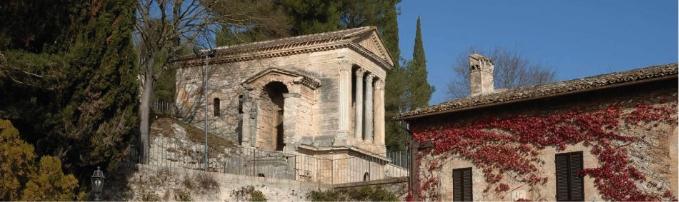
- Temple of Minerva: a prostyle in antis temple with Corinthian columns erected in 30 BC, probably dedicated to Hercules. The current name derives from the discovery of a female statue identified with the goddess Minerva. In the 16th century, the building was transformed into the Church of Santa Maria sopra Minerva, modified in the 17th century in Baroque style, with the adjoining bell tower known as the “Torre del Popolo.”
- Remains of the Roman forum: from the Romanesque crypt of the former Church of San Nicolò, one can access the Roman forum. On its stone-slab pavement, one can still identify the temple’s foundation, a monumental cistern, a podium with seats for the magistrates, a small temple dedicated to the Dioscuri, and some tabernae—spaces once used for commercial activities.
- Roman Amphitheatre: in the Porta Perlici district, the elliptical layout of medieval houses follows the outline of Assisi’s ancient arena, built in the first half of the 1st century AD.
- Domus of Propertius: beneath the crypt of the Church of Santa Maria Maggiore is a 1st-century Roman domus. Some poetic verses engraved on the walls suggest that the owner of this refined house was an educated man with a passion for poetry, identified as the Latin poet Propertius, a native of Assisi.
- Domus of the Lararium: a private residence dating from the second half of the 1st century BC, discovered in 2001 beneath Palazzo Giampè. It consists of a peristyle and thirteen rooms with mosaic floors and frescoed walls in an exceptional state of preservation. The name derives from the discovery of a statue of a Lar, a household deity believed to protect the family.
Discovering Assisi: Must-See Sites in the Umbrian UNESCO City
Many of the landmarks that make Assisi an unmissable destination, dotted with imposing buildings, basilicas, and refined churches, are closely tied to the Franciscan spiritual message:
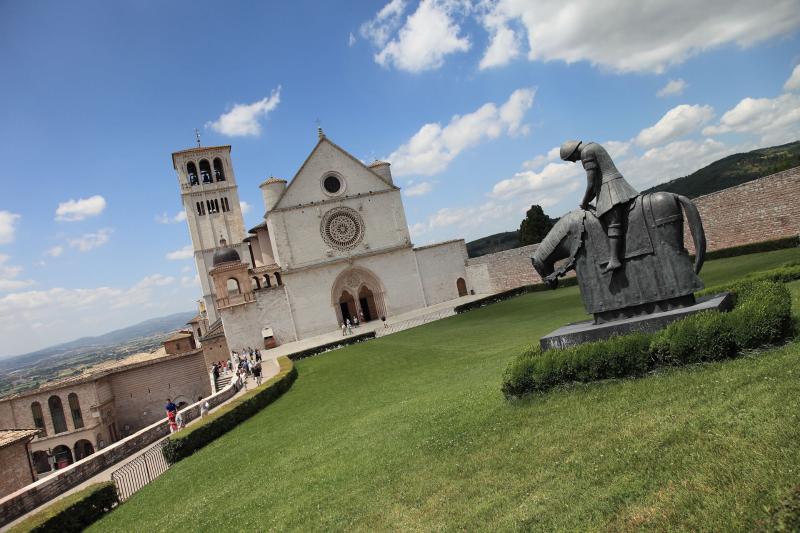
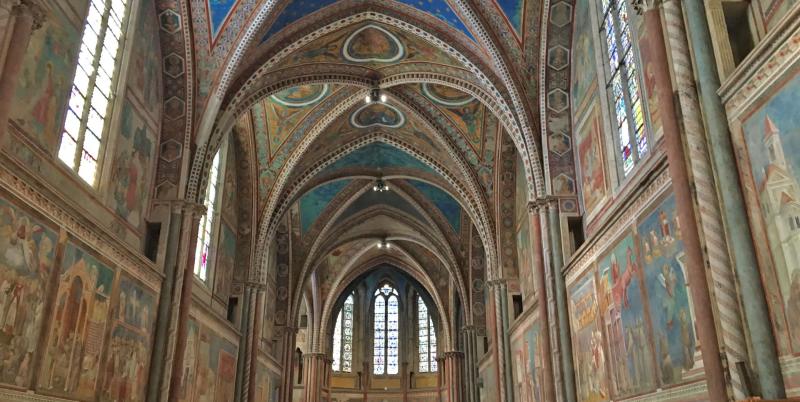
- Basilica of Saint Francis: its construction began two years after the saint’s death, and in just two years the Lower Basilica was completed, while the Upper Basilica was consecrated in 1253. Its decoration is the work of the most illustrious painters between the 13th and 14th centuries, such as the Master of Saint Francis, Cimabue and Giotto, who painted the “Stories of Saint Francis” in the Lower Basilica.
- Basilica of Saint Clare: recognizable for its façade alternating bands of white and pink Subasio stone, it was built four years after the death of the saint’s most devoted disciple, which occurred in 1253.
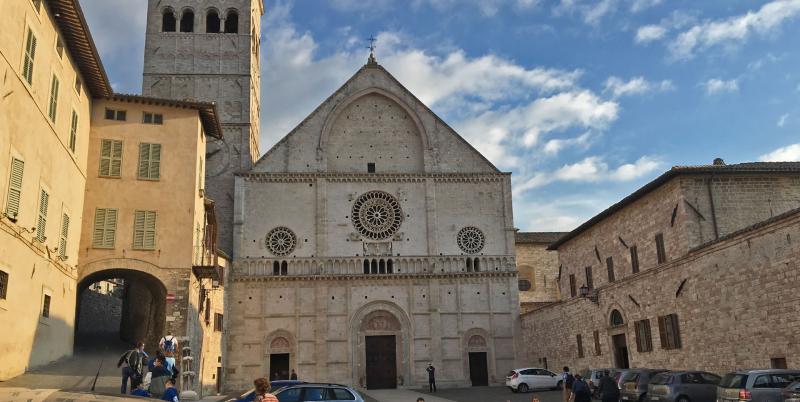
- Cathedral of San Rufino: built over the terrace of the Roman forum where the temple of Bona Mater once stood, it was begun in 1029 and elevated to cathedral status in 1036. The façade is a Romanesque masterpiece with three portals surmounted by three rose windows, while inside is preserved the baptismal font in which Saint Francis and Saint Clare were baptised.
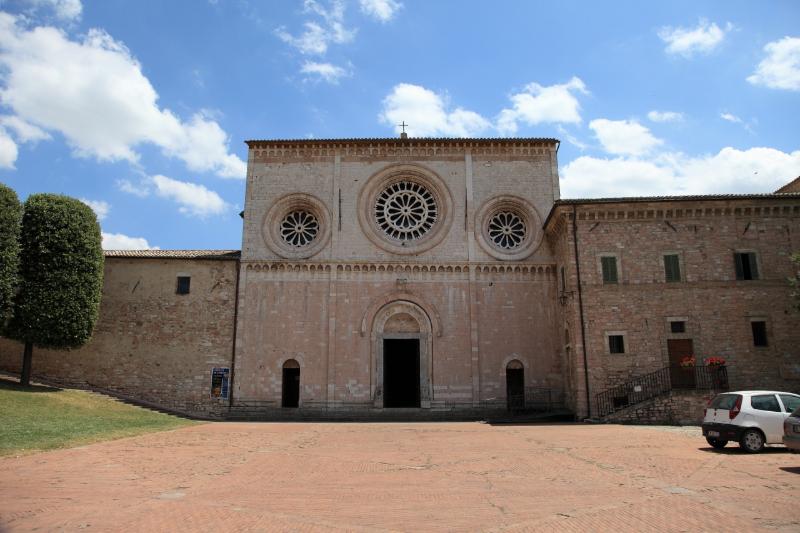
- Abbey of Saint Peter: located in the square of the same name on the edge of Assisi’s historic centre, it was founded by Benedictine monks at the end of the 10th century in an area once occupied by an ancient Roman necropolis. It underwent several renovations until its definitive reconstruction in the 13th century.
- Church and Convent of San Damiano: built between the 8th and 9th centuries in honour of Saint Damian, a physician saint, in 1030 it became an important Benedictine priory. It was gradually abandoned until 1212, when Saint Francis himself took care of the restoration. Here he welcomed Saint Clare and composed the Canticle of the Creatures.
Civil Architecture: From the Commune to the Albornoz
Some of Assisi’s buildings recount the historical events of a city long contested between ducal, communal, and papal rule:
- Torre del Popolo (Tower of the People): the construction of this tower, 47 meters high, was completed in 1305, as stated in the inscription at its base.
- Palazzo del Capitano del Popolo (Palace of the Captain of the People): built in 1275 over private buildings to house the magistracy of the Captain.
- Palazzo dei Priori (Palace of the Priors): seat of the homonymous magistracy, its construction began in 1275 and was completed in the first half of the 14th century. Destroyed in 1442 by the Perugian army, it was restored at the end of the 15th century under Pope Sixtus IV. It features an underground space at the level of Roman pavement, the Monte di Pietà on the ground floor, and the Priors’ residential rooms on the upper floor.
- Rocca Maggiore (Major Fortress): first mentioned in 1173–1174, it can be reached from Porta Perlici. Destroyed in 1198 during the popular uprising that ended Duke Conrad of Urslingen’s rule, it remained abandoned until 1356 when Cardinal Albornoz rebuilt it while preserving the fortress’ original layout.
What to See in the Surroundings
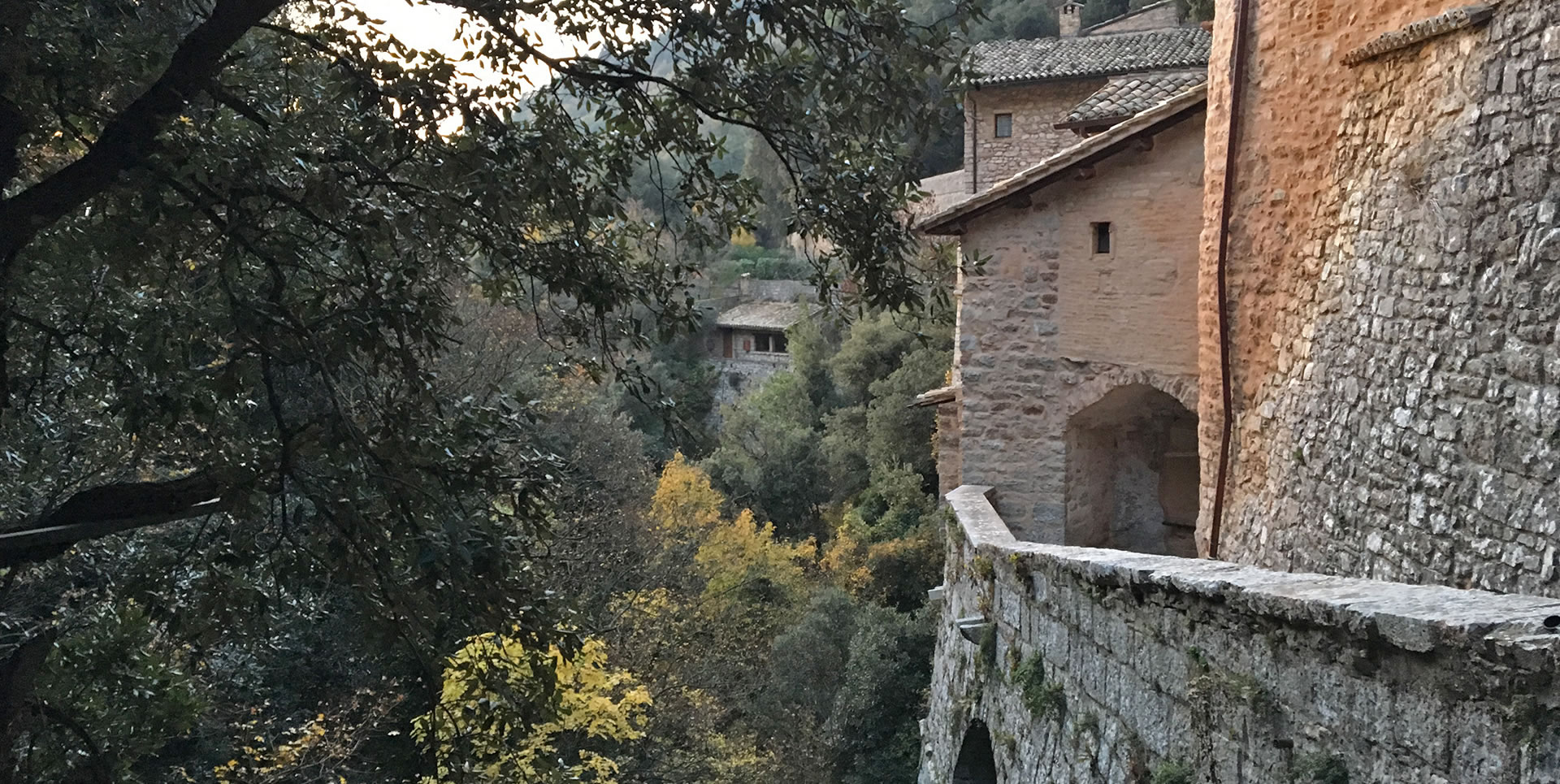
- Eremo delle Carceri: about 4 km from the city, the hermitage stands in a dense holm oak forest on the slopes of Mount Subasio, where Saint Francis and his companions “imprisoned” themselves in prayer. Nearby is also the Cave of Saint Francis.
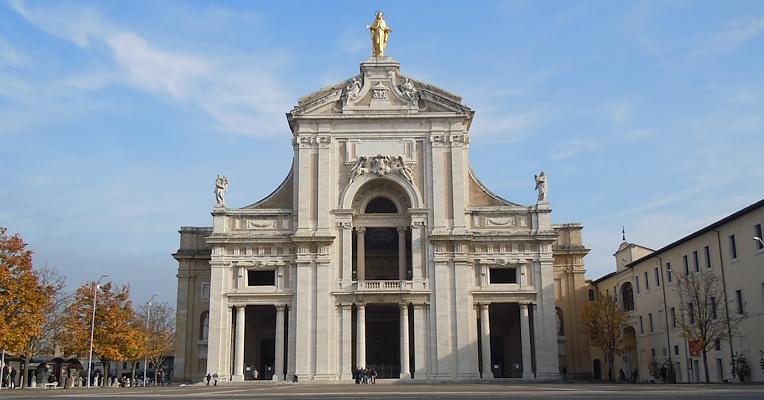
- Basilica of Santa Maria degli Angeli: built between 1569 and 1679 in the hamlet of the same name, about 6 km from the city centre. The building was commissioned by Pope Pius V to protect the humble convent that had arisen around the Porziuncola, the small church that became the seat of the first Franciscan community, and the Chapel of the Transitus, where Saint Francis died on October 3, 1226.
- Sanctuary of Santa Maria di Rivotorto: built in neo-Gothic style after the earthquake of 1854, which almost completely destroyed the earlier building erected to protect the Tugurio, the humble shelter where Saint Francis would retreat in prayer with his companions.
A Dive into Nature Around Assisi
Nature lovers can enjoy walks in the Wood of Saint Francis, restored by FAI (Italian Environmental Fund) and open to visitors and pilgrims since 2011. The forest, considered a treasure trove of biodiversity, also hosts the Land Art installation Third Paradise by Michelangelo Pistoletto.
The trails crossing the Monte Subasio Regional Park are also worth exploring. This area of great environmental value includes five Sites of Community Importance (SIC), established to protect the natural habitats and biodiversity that make the park unique, a place where the spirituality that inspired Franciscan thought can still be felt.