
Art

Three Days and Three Itineraries to Discover Perugino

Day One: From Città della Pieve to Fontignano

Pietro Vannucci, known as Perugino (Città della Pieve, c. 1450 – Fontignano, 1523), was one of the undisputed protagonists of Renaissance painting. The “best master in Italy” of the late 15th century was not only a great artist but also the inventor of a pictorial language—the “Italian school”—characterized by soft, hazy landscapes and elegant, gentle figures. Through this style, he bridged the Early Renaissance with more mature artistic formulas and motifs, later perfected by his most renowned pupil, Raphael Sanzio of Urbino.

Born in the village of Città della Pieve, near Lake Trasimeno, Perugino received his initial artistic training in Perugia, the city from which he took his nickname, before moving to Florence to study in Verrocchio’s workshop alongside Leonardo da Vinci, Sandro Botticelli, Domenico Ghirlandaio, Lorenzo di Credi, and others.

After admiring his masterpieces, take a moment to appreciate the surrounding landscape: you will recognize the gentle hills, lakes, and rivers in the distance, masterfully incorporated into the backgrounds of his Madonnas and saints in ecstasy and prayer.

This first day is dedicated to discovering his works through a 30-kilometer itinerary that starts in Città della Pieve and continues to Panicale and Fontignano.

Marker
Stop 1
Città della Pieve

Città della Pieve, a borderland between Umbria and Tuscany, shares the red-brick hues of Tuscan villages and has less winding streets than other Umbrian towns. Perched on a hill, it offers wide panoramic views of Mount Amiata, Mount Cetona, Mount Subasio, and even the distant Sibillini Mountains. These landscapes inspired Perugino, who left magnificent works from his later period in his hometown.

At the Oratory of Santa Maria dei Bianchi, you will find The Adoration of the Magi, a fresco measuring seven meters wide and six and a half meters high. In this masterpiece, the artist painted one of the broadest landscapes in his works—an idealized view from Città della Pieve towards Lake Trasimeno and the Val di Chiana. The foreground figures are elegantly posed, reminiscent of Hellenistic statues.

You will find similar influences in other works such as The Baptism of ChristThe Madonna in Glory with the Patron Saints Gervasius and Protasius, and Saint Anthony Abbot with Saints Paul the Hermit and Marcellus. The first two adorn the stunning Cathedral of Città della Pieve, while the third is housed in the church of San Pietro, just outside the town walls. At the Civic Diocesan Museum, located in the Church of Santa Maria dei Servi, you can admire The Deposition from the Cross, painted in 1517—one of the master's most significant works from his old age.

We recommend strolling through the town to discover these works, which have also been mapped into a step-by-step urban trekking route, “Perugino in Città della Pieve”, following the traces of the great painter.

Read more
Marker
Stop 2
Panicale

Panicale is a picturesque hilltop village offering a superb view of Lake Trasimeno and the Nestore Valley. Listed among “The Most Beautiful Villages in Italy”, it has also been awarded the “Bandiera arancione” (Orange Flag) for its commitment to historical landscape preservation. The village has maintained its medieval structural and architectural characteristics. Its unique concentric layout, organized around three squares at different levels, represents one of the most advanced military defence systems of its time.

Just outside the ancient walls, you will find the Church of San Sebastiano, a small 15th-century chapel with a simple design. On its back wall, you can admire The Martyrdom of Saint Sebastian, a fresco painted by Perugino in 1505.

The scene unfolds in a square, constructed with perfect geometric perspective. At the centre, on a richly decorated marble pedestal, stands Saint Sebastian, nude and tied to a column. Around him, three archers and a crossbowman move gracefully, resembling dancers rather than executioners. Through the elegant arches in the background, Perugino masterfully employs aerial perspective to create a stunning landscape. Due to the sweetness of his lines, the soft and graceful forms, and the exceptional compositional elegance, this fresco is considered one of Pietro Vannucci’s masterpieces.

In the same church, you will also find a detached fresco originally from the Church of Sant’Agostino, depicting the Madonna Enthroned, attributed to the Umbrian master.

Read more
Marker
Stop 3
Fontignano

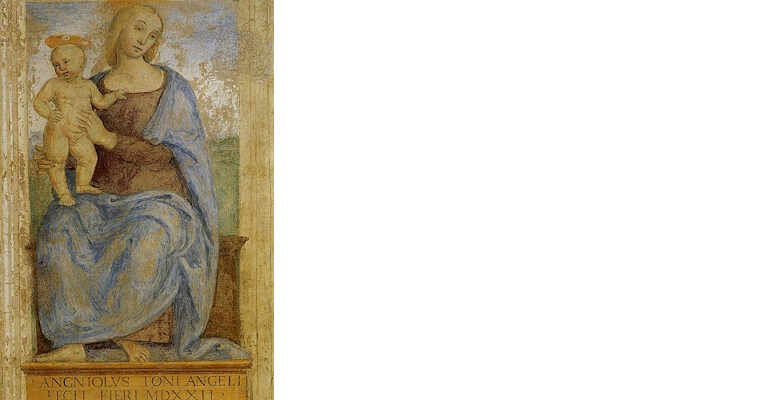
In the small hamlet of Fontignano, you can visit the simple medieval Church of Santa Maria dell’Annunziata, which houses the remains of Pietro Vannucci. The artist came to this remote village in the Perugian countryside to complete a series of frescoes commissioned by a local landowner named Agnolo. His works in Fontignano included Madonna and ChildThe Adoration of the ShepherdsSaint RochSaint Sebastian, and another Madonna and Child.

Today, only The Madonna and Child on the right-hand wall remains, as the other frescoes were removed, relocated, or lost over time. The surviving fresco was also covered at an unspecified time, later freed from the layer of lime that concealed it and heavily restored. The faces are likely the only parts executed by Vannucci, as they reveal the sweetness and serenity characteristic of the painter's figurative language.

Recently, restorers uncovered the preparatory drawing for The Adoration of the Shepherds, an extensive fresco that once covered the church’s back wall. The fresco was removed and is now housed at the Victoria and Albert Museum in London. Art historian John Ruskin described it as “the most beautiful fresco I have seen outside Italy”. These faint traces stand as a final testimony to the Umbrian painter's artistry—almost a ghostly presence of his work, which played such a crucial role in Italian art history.

While painting these frescoes, Pietro Perugino, by then in his seventies, succumbed to the plague and died. Out of fear of contagion, he was hastily buried outside the village. About fifty years later, the Confraternity of the Annunziata exhumed his remains and reinterred them outside the church, without a tombstone or cross.

Since 1929, the great Umbrian painter has rested in a marble urn inside the Church of Santa Maria dell’Annunziata.

Read more