If you love ghost stories and mysteries, get ready for a ghostly adventure, among legends and apparitions, in the castles and monasteries of Umbria. Here are some suggestions for a chilling experience in our region.
Ghost Stories Umbria - Ghost Stories Umbria
Ghost Stories in Umbria
Palazzo Vitelli alla Cannoniera
In the historical centre of Città di Castello is Palazzo Vitelli alla Cannoniera, a magnificent Renaissance residence housing important works of art and home to the Municipal Art Gallery. Inside its elegant rooms, the ghost of Sora Laura is said to roam.
This story dates back to the first half of the 16th century when, after marriage, the condottiero Alessandro Vitelli and the noblewoman Angela Paola dei Rossi di San Secondo Parmense decided to build the palace. The condottiero was known to be a womanizer and soon fell in love with a young woman named Laura. In order not to be discovered, Alessandro had his wife moved to another family palace and reserved Palazzo Vitelli alla Cannoniera for his lover. While waiting for her lover to return from his military campaigns, the young woman devoted herself to embroidering handkerchiefs, but one day, tired of waiting for her lover, she saw a handsome knight from the window of her room and, to attract his attention, threw a handkerchief out of the window. The knight, fascinated by the young woman, accepted her invitation to bring the handkerchief back to the palace. After the first passionate encounters, for fear of being discovered by Vitelli, she decided to use a trick to make her lover fall into a trapdoor where an atrocious death awaited him, pierced by the blades of the bottom. The same fate befell other young men, seduced by her beauty, until the day she herself was killed, by a hitman sent by Vitelli's wife, who discovered the betrayal.
Legend has it that the ghost of the young woman, trapped in the palace, is tormented by remorse and is still seeking forgiveness. It is said that some photometric surveys and acoustic monitoring carried out in 2012 seem to have captured the shadow of a young woman in Renaissance clothing.
Castel d’Arno
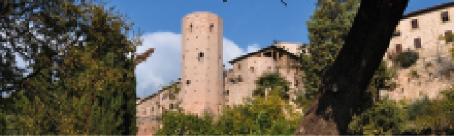
Descending into the heart of the region, a few kilometres from Perugia, is a small fortified village, Castel d'Arno, where other ghostly stories are told.
Between the 16th and 17th centuries, this place became the refuge of a band of brigands, relatives and servants of the bloodthirsty Colonel Francesco Alfani. The latter moved to the family's former estate after being banished from Perugia due to a series of personal vendettas linked to an insult received from a nobleman. For revenge or money, he committed various crimes and it is said that he buried his victims still alive in the garden of Castel d'Arno. A popular tale has it that on nights when the moon is full, the voices of the victims can still be heard calling for help. Today, the place, which is partly abandoned, is used as an olive grove.
Another scary story is linked to the Alfani family. The story goes that three masked hunters met a peasant girl near the village and asked her if there were any hares to hunt. The girl replied that the 'Alfanacci', well-known brigands of the area, had eaten them all. But under the big hats that hid the hunters' faces were the three Alfani brothers, who took the poor peasant girl and put her into the oven where the wood was already burning.
Stone Tower in Macereto
The journey continues to a small castle dating back to the 14th century. We are at an altitude of 300 metres above sea level, in Macereto Alto, a hamlet of the municipality of Piegaro in the province of Perugia. We get there by following the Via Pievaiola, the road connecting Città della Pieve to Piegaro. The earliest settlement in this area is unknown, but reconstructions date back to 1443, when a condottiere from Bergamo, Antonio Attendolo, called Ciarpellone, after attacking the peaceful village of Piegaro, decided to also assault its defensive stronghold, the Castle of Macereto.
And it is here, to this day, that a phantom platoon of those soldiers who, guarding the castle, were exterminated that night in the brutal attack is still recorded. On full moon nights, near Poggio delle Forche, the soldiers, with their skeletal faces and hollow, eerie eyes, would roam about, attempting to defend it forever.
Ghost Monks of Subasio
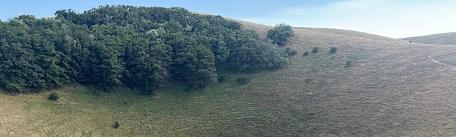
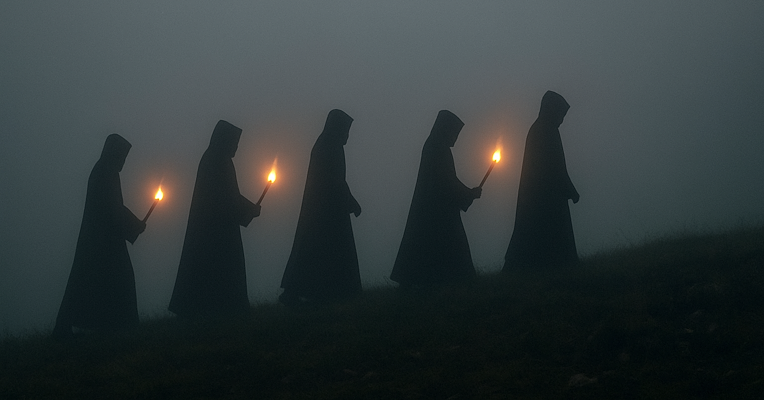
In a remote area of the Umbrian hills behind Assisi, beneath Mount Subasio, legend has it that a monastery once stood there, of which now not even its ruins remain. The monks who lived there were not devoted to prayer—instead, they led corrupt and dissolute lives, committing grave sins again and again. Perhaps due to an epidemic, or rather as a divine punishment, all the monks died within a short time, and the monastery was destroyed. Soon after, locals began speaking of eerie presences: on the darkest nights, shadowy figures could be seen walking in procession, their invisible faces lit by flickering torches, while a mournful chorus of chants and prayers rose into the cold air. It soon became clear that these shadows were the ghosts of the damned monks, condemned to wander restlessly, forced in death to display the devotion they had denied in life. Even today, some claim that by venturing into the hills of Subasio at night, one can still hear and glimpse these ghosts, suspended in a limbo of eternal penance as they seek to atone for their sins.
The Chamber of Torments in Narni
Let's move on to the province of Terni. Have you ever been to the underground passages of the city of Narni?
They are open to the public and, thanks to a guided tour, you can take an unconventional route to discover as many mysterious stories. In particular, right at the start of the tour, you enter the convent complex of San Domenico, which leads to the entrance of a 12th-century church. This was a discovery made by six young speleologists in 1979. The most striking part that makes us continue on this dark and paranormal journey is the arrival at a large room, called the Room of Torments, where interrogations by the Inquisition Tribunal took place.
Graffiti marks on the walls document the presence of the interrogators. In particular, a cell adjacent to the room contains a rich variety of alchemical symbols, drawn by the prisoner Giuseppe Andrea Lombardini, who spent about ninety days there between 1759 and 1760. Thanks to the visit, one can discover the meaning of this graphic code, a true journey into the depths of the unconscious, as well as experience first-hand the legend of the presence of his ghost that tirelessly roams the interior of these dungeons.
Vampire of Lugnano
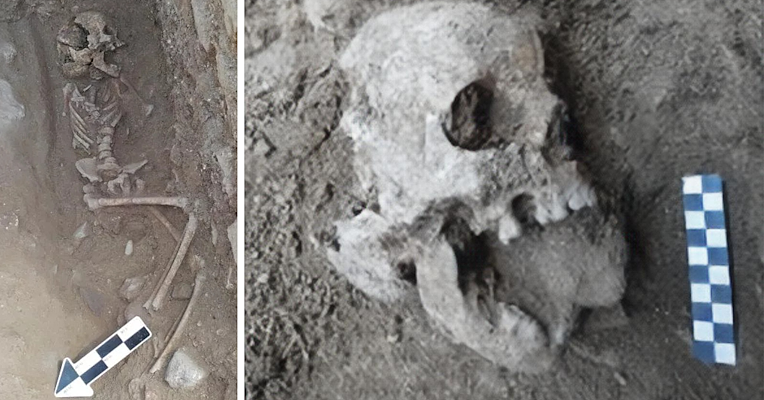
Among the silent hills of the middle Tiber Valley, not far from the village of Lugnano in Teverina, lies a place as mysterious as it is unsettling: a children’s necropolis.
Here, among the ruins of a Roman villa from the Augustan age, a burial ground for infants was established in the 5th century. What is most striking is the tragic tenderness evoked by these graves: a relentless and invisible malaria epidemic seems to have prematurely claimed many young lives.
Of the more than sixty graves discovered - many of which followed the practice of enchytrismos, where the body was placed in a fetal position inside terracotta amphorae - one stands out as especially mysterious.
The skeleton of a girl, about ten years old, was found with a large stone placed in her mouth - a ritual gesture, perhaps, meant to prevent her from returning from the afterlife to haunt - or rather infect - the living.
This is how the burial was named the “Vampire of Lugnano,” a name that still echoes with ancient superstitions and a mystery that refuses to be silenced.
What do you want to ask me?