





.jpg/e9571273-0e35-1ff2-0713-76c7fd4e3cc5?width=456)

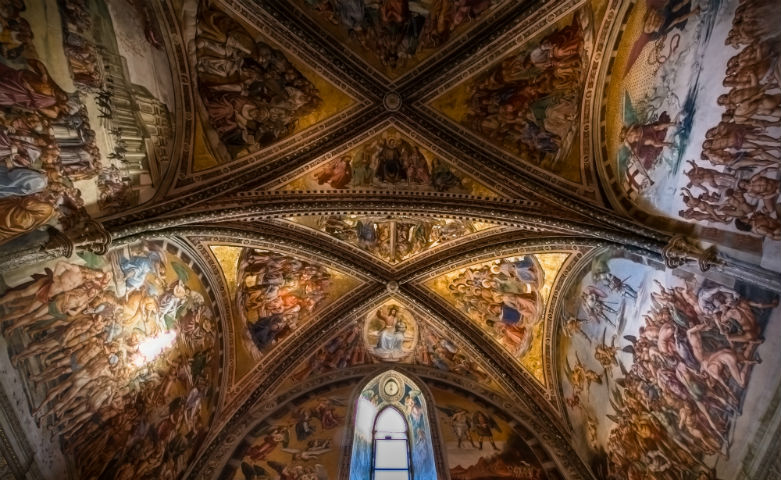
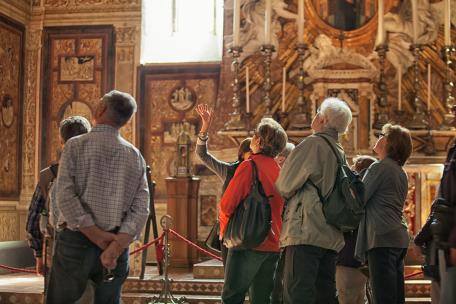
The Chapel of Saint Brizio inside Orvieto's Duomo
Luca Signorelli is undoubtedly one of the leading figures of the Italian Renaissance. The painter, originally from Cortona, worked extensively in Umbria, leaving remarkable works in the Upper Tiber Valley, now preserved in the Pinacoteca of Città di Castello and in the National Gallery of Perugia.
Inside Orvieto Cathedral, the Tuscan master created one of his most accomplished works: the Cappella Nova, also known as the Chapel of San Brizio. In 1499 Luca Signorelli signed the contract to complete the decoration of the chapel’s vaults. The earlier phase of the decoration had been begun by Fra Angelico. Signorelli overturned the previously used approach, which was typically medieval in character: the painter from Cortona placed the observer at the very center of his composition and brushwork, offering a powerful and harmonious overall vision.
One feature you cannot fail to notice is the illusionistic perspective of the walls, which transforms the chapel from a Gothic structure into a Renaissance space. Through this effect, the artist visually sets the walls back by about two meters, making the building appear as high as it is wide.
Above you unfold the scenes of the Last Judgment and the Antichrist: observe them carefully, for they form one of the most celebrated pictorial cycles of the Italian Renaissance.
In the first lunette on the right wall, you can see the Resurrection of the Flesh, where Signorelli’s genius and dramatic intensity fully emerge. The figures are portrayed in the prime of physical vigor, all around thirty years of age: some appear fully covered with skin and muscles, others rise as skeletons, while one resurrected figure is captured in an intermediate stage, covered with skin but not yet with muscles.
In the following lunette, the scene of Hell unfolds. This was the first fresco painted by Signorelli and depicts a dense turmoil of intertwined human and demonic bodies, rendered with striking visual impact, enhanced by the vivid color palette. Here the painter employs the technique of cross-hatching, creating an extremely effective optical synthesis.
The corresponding lunette on the left side depicts Paradise. According to theological tradition, the figures express serenity. Above them nine angels perform together in a celestial concert. Although the instruments and the positions of their hands are portrayed with convincing realism, the ensemble represents an imaginative and symbolic musical group, evoking the harmony of heaven. To emphasize this heavenly atmosphere, two angels at the center scatter roses and camellias over the blessed. These flowers were painted a secco and, unfortunately, today only faint traces remain.
On the far wall is the Vestibule of Hell, inspired by Dante’s Purgatory. At the top, a group of the ignavi (the indifferent souls) chase a demon carrying a white banner; at the center stands Charon ferrying other damned souls across the river. Above him appears Minos, assigning punishment to a sinner held by the hair by a devil, while wrapping his tail around his body as many times as the circle of Hell to which the soul is condemned.
On the left side you can see the Calling of the Elect. At the top, angels playing musical instruments accompany the blessed, whom other angels are preparing to lead into Paradise. At the center, in the window embrasure, are depicted two bishop saints who are patrons of Orvieto: Saint Constantius and Saint Brizio. In the inner arch of the window are Saint Michael the Archangel weighing souls and Saint Michael driving away a demon; in the right window appear the Archangel Gabriel with Tobias and the Archangel Raphael.