From popular tradition to the building of a sanctuary
The documentation concerning the practice of the laying on of hands is extensive, and authoritative attestations have been recorded of the healings obtained. These practices, condemned by the Council of Trent, were strictly prohibited in 1586 by the bishop of Foligno, Marco Antonio Bizzoni. However, he was forced to revoke the ban when, suffering from sciatica himself, he had to turn to the Cancelli family for healing. The influx of the sick and pilgrims into the humble room of the family home made it necessary, in the mid-17th century, to build a small church in the form of an oratory.
The building, however, proved inadequate to accommodate the growing number of faithful. Thus began the construction of a large sanctuary, since most of the people could not fit inside the first structure and had to attend Mass outside the oratory, as attested by the foundation document of 1744, preserved in the episcopal chancery of Foligno. Between 1744 and 1765, under Bishop Mario Antonio Maffei of Foligno, the present church was built, dedicated to Saints Peter and Paul. The project was most likely entrusted to Filippo Neri, an architect from Foligno. The structure has recently been restored and reopened for worship.
The Church of Saints Peter and Paul and the “Chamber of the Apostles”
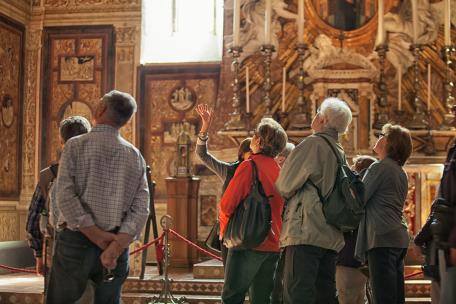
The church was built above the room where, according to tradition, the apostles Peter and Paul were hosted, and where the Cancelli family carried out the healing rite. It has a Greek-cross floor plan, with three altars: at the main altar there is an interesting altarpiece depicting Saints Peter and Paul, a mid-18th-century work by the Piedmontese painter Claude François Beaumont, who donated it to the sanctuary; on the left altar is a painting by an unknown artist depicting the Virgin among Saints; the right altar hosts a fine 18th-century canvas of Saint Felician, painted by Antonio Coccetti from Foligno.
Behind the main altar, two flights of stairs lead to the crypt, or “Chamber of the Apostles,” the modest room that, according to tradition, gave shelter to Saints Peter and Paul, and where the rite of the laying on of hands between healer and sick person took place – and still does today.
On the Feast of the Ascension and on that of Saints Peter and Paul, June 29, the Sanctuary is still the destination of an important pilgrimage, with many faithful coming to receive the segnatura (the healing sign) from the last descendant of the Cancelli family.







.jpeg/0963e313-3fe7-31da-b05c-a3c6aca0a775?width=456)
.jpg/82d76794-ab9b-f87f-b9e6-5f77e6eb3b4c?width=456)





.jpeg/26712e88-9665-3ae2-a85e-3bd2b38b8a93?width=780)