



Low-angle view of the 18th-century façade and stone bell tower with clock of the Church of Santa Cecilia.

Church of Santa Cecilia - Acquasparta

Right in the centre of Acquasparta, where the main street runs alongside Palazzo Cesi, stands the Church of Santa Cecilia, the patron saint of the town. Of medieval origin but extensively transformed in the eighteenth century, the building preserves artistic and architectural evidence linked to the history of the community and the Cesi family.

One of its most noteworthy features is the Chapel of the Most Holy Crucifix, commissioned in 1581 by Isabella Liviani Cesi, great-grandmother of Federico Cesi the Lincean, founder of the Accademia dei Lincei.

From Romanesque origins to the eighteenth-century reconstruction

The earliest traces of Santa Cecilia date back to the eleventh century, when a Romanesque place of worship stood in the area now occupied by the presbytery. At the end of the 13th century, it was replaced by a larger building with three aisles divided by travertine columns.

The antiquity of the worship is recalled by Bonaventura Pianegiani, episcopal chancellor of Todi, who, in an 1867 manuscript, describes the medieval structure and mentions a very ancient consecration. Further evidence emerged from excavations carried out beneath the presbytery in the 1970s, which brought to light masonry and stone materials suggesting that the site was in use even before the Romanesque building was constructed.

In the fourteenth century, the church was granted the title of Insigne Collegiata (Distinguished Collegiate Church), reflecting its growing religious importance. In the sixteenth century, further works were undertaken, including the construction of the bell tower, begun in 1574, and the funerary chapel of the Liviani Cesi family.

The present appearance of the church, however, dates from the reconstruction of 1761, promoted by Duke Carlo Muti Cesi, the community of Acquasparta and the local confraternities, based on a design by the Roman architect Pietro Fontana. The project profoundly transformed the medieval building. The new church was consecrated on 22 May 1763 by the Bishop of Todi, Francesco Maria Pasini.

The façade and the ancient bell tower

On the outside, the gabled façade is divided into two levels by a horizontal string course and articulated by pilasters. At the centre is the entrance portal, topped by a pediment; above it, a large window illuminates the interior. A triangular pediment crowns the façade.

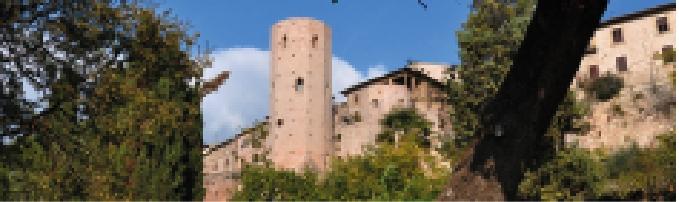
On the right-hand side stands the imposing stone bell tower, built using stone materials taken from ancient rural churches in the surrounding area, located along the Via Flaminia. Before the eighteenth-century reconstruction, the tower stood outside the main body of the church. Over the centuries, it underwent numerous alterations, particularly to its upper section, which was once crowned by a spire.

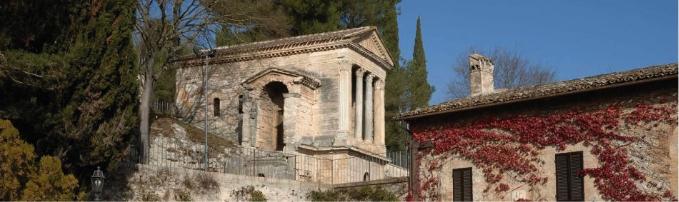
A little further on, the external elevation of the Chapel of the Most Holy Crucifix can be seen, offering valuable evidence of the late Renaissance period and the church's connection with the Cesi family.

Art and memories of the Cesi family

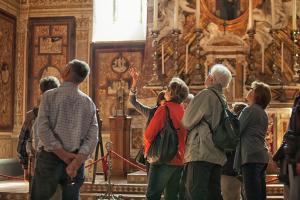
The interior is a spacious, light-filled single-nave layout, embellished with eighteenth-century stuccoes and decorations. Along the walls are side chapels, once entrusted to noble families and confraternities, as recalled by their coats of arms that are still visible.

The Chapel of the Most Holy Crucifix, known as the Cesi Chapel, was built in 1581 at the behest of Isabella Liviani Cesi as a family burial place. Having survived the eighteenth-century reconstruction almost intact, it preserves the funerary memorials of the Liviani and Cesi families, including that of Federico Cesi the Lincean, who died in 1630.

Above the altar hangs a valuable painting depicting the Crucifixion with the Virgin Mary, Saint John the Evangelist and Mary Magdalene. It also features a portrait of the patron, Isabella Liviani Cesi, shown in prayer. The work, created in 1581, is by Giovan Battista Lombardelli, a painter who also worked on the decorations of Palazzo Cesi.

The other chapels house paintings dating from between the late sixteenth and eighteenth centuries: the Adoration of the Shepherds, the Madonna of the Rosary with Saint Dominic and Saint Catherine of Siena, and the painting depicting Saints Nicholas, Barbara and Restituta. The latter recalls the devotion to the patron saints of some of the ancient rural churches in the area, from which the materials used to build the bell tower were sourced.

At the centre of the apse stands the high altar dedicated to Saint Cecilia, surmounted by a painting of the patron saint. On the triumphal arch, supported by two angels, is the coat of arms of the Cesi family, lords of Acquasparta since the sixteenth century and long-standing benefactors of the collegiate church. The presbytery is completed by a walnut-wood choir dating back to the eighteenth-century reconstruction.

Finally, among the works preserved here is a wooden Crucifix of the Umbrian school from the early fourteenth century, originally housed in the Church of San Giovanni de Butris, later transferred to San Francesco and eventually placed in Santa Cecilia on the occasion of the Jubilee of 2000.

Explore the surroundings
Main attractions in the vicinity