The castle of Macerino: defensive and religious structures
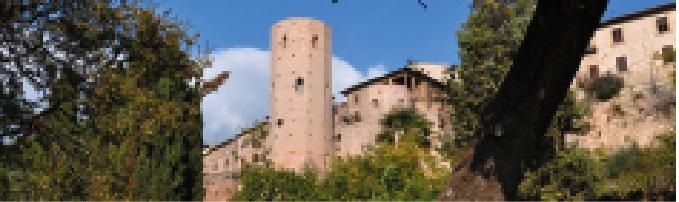
Macerino’s past as a political and strategic centre is still evident in its defensive structures. The castle preserves its walls, with four imposing corner towers and the entrance gate, above which the community’s coat of arms is carved.
Several religious buildings stand both inside and near the castle:
- Church of San Biagio: built in the 10th century within the castle, opposite Palazzo Massarucci (16th century), it stands against the ancient keep of the defensive walls. Its interior has three naves, five altars, and a cycle of frescoes in the apse dedicated to the patron saint.
- Church of Madonna in Fiore: a small devotional building constructed in 1670 just outside the castle walls. Inside, frescoes decorate the side walls and the back wall, featuring the Madonna and Child crowned by angels, flanked by Saints John the Baptist and Charles Borromeo.
- Church of San Giovenale: located near the cemetery of Macerino, it features a pentagonal apse. Inside, the apse preserves frescoes from different periods, including a 13th-century depiction of Saint Francis in ecstasy by an anonymous Umbrian painter, and 17th-century paintings of Saint John the Baptist, Saint Giovenale wearing episcopal vestments, and Saint Roch.
A bridge through time: from Ponzia to Lucrezia Borgia
The ancient route across the Monti Martani, now known as the “Sheep Road,” has preserved its role over the centuries as a route for travel and transhumance.
Near Macerino, this path is marked by a striking monumental bridge, likely dating back to the 18th century but traditionally known as the “Ponte Romano” (Roman Bridge). Its evocative name recalls distant stories and intertwines with the journeys of remarkable women—both real and legendary—who passed along this route.
The story of Ponzia: memory carved in stone
Inside the Church of San Giovenale, an Early Christian marble sarcophagus dating to the second half of the 4th century was discovered and is now preserved in the National Archaeological Museum of Spoleto.
This refined tomb belonged to Ponzia, a Roman noblewoman from Sardinia traveling to Trier, who died after falling from her horse near Macerino, in a place known as Ripe Rosse or Pietra Rossa.
Only two large fragments of the front panel remain today, but thanks to a description written in 1712 by Bishop Lascaris, its original appearance can be imagined. At the centre was a circular clipeus bearing a Christogram flanked by Alpha and Omega, with a blessing Christ inscribed within a square decorated with lilies, and two Muses on either side. The monument also featured poignant verses carved on the sides, in which Ponzia’s husband mourned her premature death, which occurred before ten years of marriage and without heirs.
The presence of the sarcophagus in the Church of San Giovenale suggests that her body was brought to the nearest sacred area. Archaeological findings confirm the existence of an Early Christianburial area, likely connected to a place of worship.
Lucrezia Borgia in Portaria: stories of life and legends of death
In 1499, another famous woman traveled this route: Lucrezia Borgia. The daughter of Pope Alexander VI and governor of Spoleto, she was sent from Rome to take possession of the city. Pregnant at the time, she passed through the area with her escort, stopping in Portaria, where she stayed at the castle.
Numerous legends surround her figure. One of the most famous concerns the so-called “Palazzaccio” near Lake Firenzuola, believed to have been one of the residences of the Cesi family. According to tradition, it was here that she imprisoned her lovers, condemning them to a long captivity. Even today, it is said that on windy, rainy nights, their cries can still be heard from the underground chambers.
Did you know? Macerino, a land of artists and actors
In the 1970s, Palazzo Massarucci in Macerino became the residence of the daughter of composer Gustav Mahler, a well-known sculptor.
The medieval castle also served as a filming location for the TV movie La terra del ritorno, starring Sophia Loren and Sabrina Ferilli.