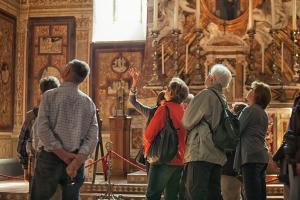
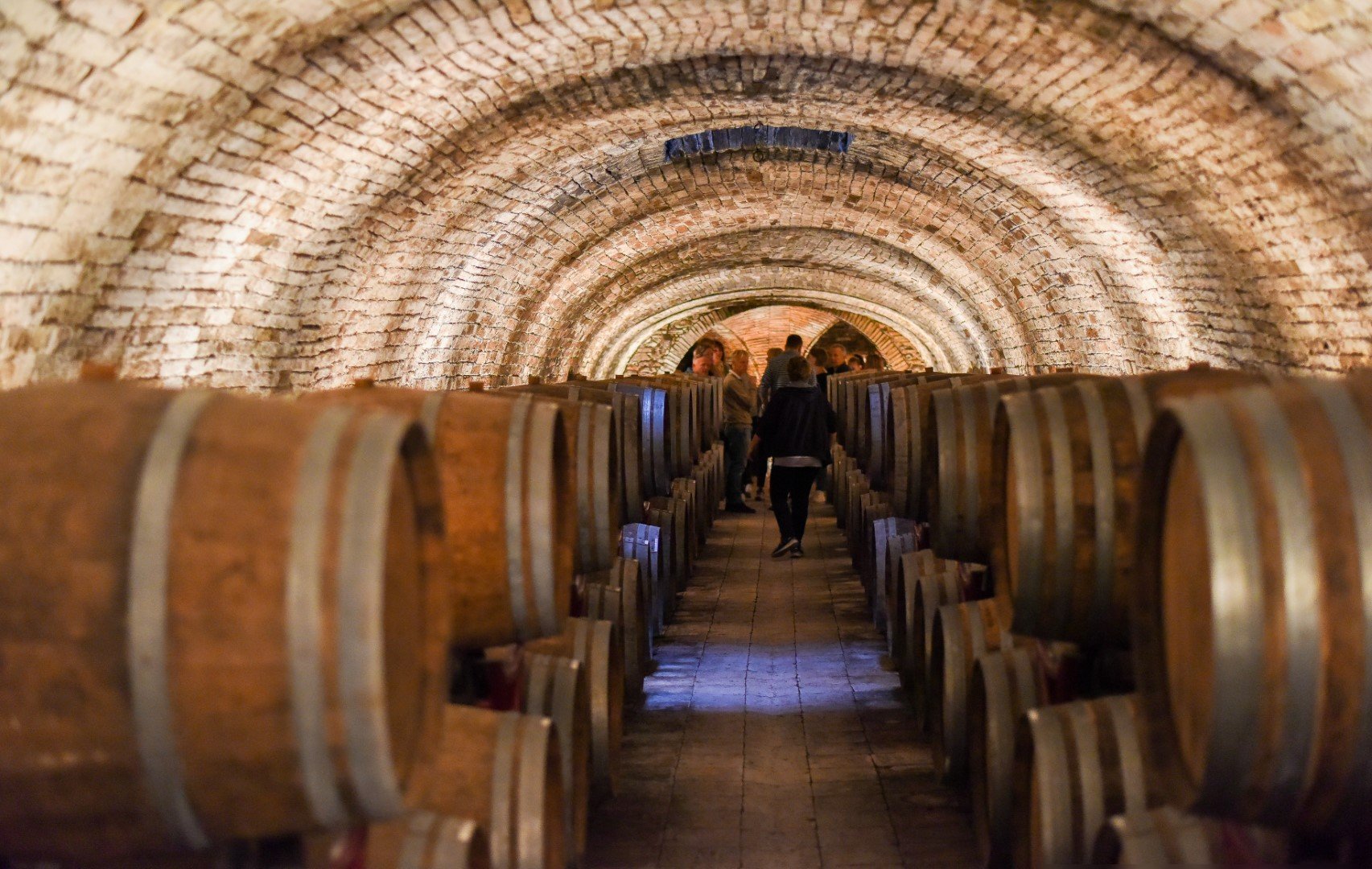
Ancient tools, presses and barrels displayed at the Torgiano Wine Museum, dedicated to the history of winemaking.
Wine and oil routes
Museums

Wine and Olive Oil in Umbria’s Museums

An itinerary through places, collections and traditions that tell the story of Umbria’s identity
Marker
Stage 1
Wine Museum (MUVIT) – Torgiano

In Torgiano, wine is not simply one of the area’s finest products: it is the protagonist of a story spanning thousands of years, told through the collections of the Wine Museum (MUVIT). Housed in Palazzo Graziani-Baglioni since 1974, the museum was founded by Giorgio and Maria Grazia Lungarotti.

The exhibition invites visitors to explore the history of wine production through collections ranging from antiquity to the present day: from archaeological finds dating back to the Roman period to early medieval and Renaissance maiolica by Mastro Giorgio, as well as works by major artists such as Mantegna and Picasso.

The story is also told through the tools traditionally used in vineyard work and winemaking. Among the most impressive exhibits is the monumental “Catone” wine press, built in the 18th century and used until 1973.

Discover the wineries in Torgiano where you can enjoy tastings and unique experiences.

Read more
Marker
Stage 2
Olive and Olive Oil Museum (MOO) – Torgiano

Also in Torgiano, an old olive mill is now home to the Olive and Olive Oil Museum. Its eleven exhibition rooms take visitors on a fascinating journey through time, from the mythological origins of the olive tree to the present day, revealing the history of one of the crops that has most profoundly shaped the Mediterranean landscape and culture.

The journey begins in Umbria with an exploration of the botanical characteristics of the olive tree and the cultivars grown throughout the region, before tracing the evolution of cultivation techniques and oil extraction methods. Tools and olive-processing machinery illustrate the transition from ancient production techniques to modern extraction systems.

Archaeological finds, oil lamps and other objects then reveal the many uses of olive oil over the centuries: from food and medicine to cosmetics and lighting. Finally, the exhibition moves into the realms of myth and spirituality, exploring how the olive tree became a symbol of peace, prosperity and rebirth. A museum that symbolically captures thousands of years of history in a single drop of olive oil.


Discover the olive mills in Torgiano, where you can enjoy tastings and unique experiences.

Read more
Marker
Stage 3
Museum of Olive Growing and Olive Oil Culture – Trevi

In Trevi, you only have to look across the surrounding hills to understand how deeply the town’s history is intertwined with the olive tree. The landscape, distinguished by its sweeping olive groves, tells the story of a centuries-old relationship between olive growing and the Umbrian countryside. This bond lies at the heart of the Museum of Olive Growing and Olive Oil Culture, housed within the San Francesco Museum Complex.

The museum explores the olive tree from a variety of perspectives, bringing together botany, agricultural techniques, olive oil production, history and symbolism. Information panels, multimedia installations, machinery once used in olive mills and archaeological finds illustrate the long history of olive growing and oil production, which has shaped not only the local economy but also the very landscape of the Umbrian hills.

The story, however, extends beyond Trevi and Umbria to the wider Mediterranean. Oil lamps, unguentaria and artefacts from the ancient perfumery and pharmacy of Pyrgos on the island of Cyprus evoke the civilisations that used olive oil not only as food, but also to light their homes and to prepare perfumes, ointments and remedies.


To complete your journey through the culture of olive oil, visit Trevi’s olive mills, where you can discover the production process up close and enjoy dedicated experiences.
Read more
Marker
Stage 4
Sagrantino Museum – Montefalco

In Montefalco, a town whose identity is inseparably linked to its celebrated wine, art and the culture surrounding Sagrantino come together in one extraordinary place. At the San Francesco Museum Complex, the connection with vine growing is even reflected in the magnificent frescoes by Benozzo Gozzoli, who in 1452 depicted Montefalco surrounded by a rural landscape marked by vineyards.

But it is below ground that this story truly comes to life. The ancient cellars of the Conventual Friars Minor, built between the 15th and 17th centuries and rediscovered between 2002 and 2006, have housed the Sagrantino Museum since 2024. The original masonry vats used to collect and press the grapes can still be seen here, alongside tools and objects used in winemaking between the 18th and 19th centuries. They are displayed in an exhibition inspired by the 1798 inventory of the convent’s possessions.

From these historic spaces, visitors embark on a multisensory journey through objects, photographs, first-hand accounts and audiovisual devices, exploring the relationship between grape variety, wine, culture, landscape and tradition. From Sagrantino to the area’s other wines, the museum traces a story that begins in the ancient Franciscan cellars and continues in today’s vineyards, revealing how profoundly vine growing has shaped Montefalco’s identity and landscape.

After visiting the Museum, complete the experience by discovering where to taste Sagrantino and the other wines produced in Montefalco.

Read more
Marker
Stage 5
The Medieval Cellars of Pozzo della Cava – Orvieto

Closely linked to the city’s Etruscan origins, the Pozzo della Cava in Orvieto also offers a fascinating glimpse into medieval life preserved within the tufa rock. Beneath the medieval houses of Via della Cava lie underground rooms and storerooms, many of which were once used for the production and storage of products such as olive oil and wine.

One particularly interesting example is a multi-level cellar. The upper level was used to store olive oil and ferment grape must, while the lower cellar was used to age barrels of wine.

The two spaces were connected by an ingenious system designed to transport barrels between the two levels: the “scendibotte”, a staircase flanked by two sloping ramps that allowed the barrels to be rolled from the upper level to the cellar below. Once stored deep inside the tufa rock, the wine could undergo a slow ageing process.


From medieval production to the present day, wine has remained a key part of Orvieto’s identity. After visiting the Pozzo della Cava, discover the local wineries and taste the wines of the region, the expression of a centuries-old tradition.

Read more