


A television journey through towns and villages

Umbria, an Exceptional Setting

Can This Love Be Translated?
Perugia, the beautiful provincial capital with its sweeping views and streets steeped in history and charm, long used as a location for numerous television productions, continues to confirm its status as a point of reference for international drama.
In December 2025, the historic centre of the city hosted the filming of Can This Love Be Translated?, a Korean production for Netflix. The series tells the love story of two characters who meet within the film crew for which they both work, travelling to various countries around the world to shoot a film.
In the storyline, as well as in reality, the crew’s Italian locations are Perugia and Siena, both considered highly representative of the charm of the Bel Paese. In Perugia, filming took place in some of the Umbrian town’s most iconic spots, including Piazza IV Novembre, Via Alessi, Piazza Matteotti and the arcades of Piazza Italia.
Romantic K-dramas enjoy a vast following across Asia, and the casting of the male lead, the celebrated Korean actor Kim Seon-ho, ensures further success for the series.

Luisa Spagnoli: Queen of Chocolate
The previously mentioned K-drama was not the first time that Perugia had appeared in all its splendour on screen: the drama Luisa Spagnoli: Queen of Chocolate, devoted to the entrepreneur Luisa Spagnoli, had already attracted wide attention. She was the creator of the still-existing brand Luisa Spagnoli and, together with her husband Annibale Spagnoli, founder of Perugina, the confectionery company that played such an important role in the history of the Umbrian capital.
Scenes were filmed along Corso Vannucci, in Piazza IV Novembre, Via Alessi and on the steps of Sant’Ercolano. During the days of shooting, it was by no means unusual to come across the splendid actress Luisa Ranieri, who portrayed Luisa Spagnoli, along with many extras dressed in magnificent early twentieth-century costumes.
To discover more about the entrepreneur and retrace the history of Perugina, visitors can now explore the L.A.B. – Luisa Annibale Base – the company’s original laboratory, located at the Città del Cioccolato.

Don Matteo
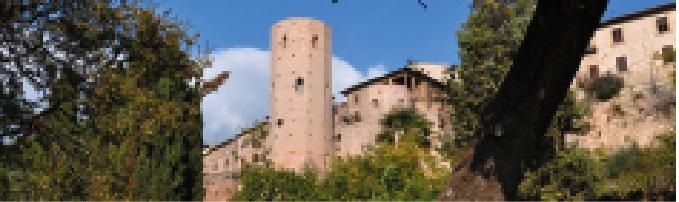
For Don Matteo, the renowned Italian television drama starring Terence Hill, Umbria has been the filming location since the very first episodes. The early seasons were shot in Gubbio, a beautiful medieval town much loved by Italian and international directors and filmmakers alike.
Its charm lies in its stone houses, its broad squares opening onto the valley below, the backdrop of mountains and woods and the splendour of its civic palaces. The Church of San Giovanni was used as the church and rectory where the priest lived, while Marshal Cecchini’s barracks were located in Piazza Grande, overlooked by the Palazzo dei Consoli, the famous setting for the chess matches between the priest and the marshal.
Viewers would often see Don Matteo cycling through the picturesque streets of Gubbio’s historic centre, such as Via Piccardi, Via Savelli, Via Galeotti and Via Baldassini.
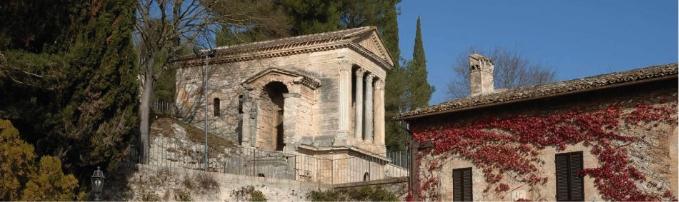
In later seasons, filming moved to another iconic Umbrian town: Spoleto. The heart of the set was the magnificent square overlooked by the Cathedral of Santa Maria Assunta, a true masterpiece of Romanesque architecture in Italy. One side of the square is home to Palazzo Bufalini, which in the series serves as the Carabinieri barracks, while the church officiated by Don Matteo is recognisable as the Basilica of Sant’Eufemia, also close to the square.
The prison interview room was recreated inside the Caio Melisso Theatre. Spoleto’s charming streets, dotted with ancient buildings and contemporary works of art, frequently provide the backdrop for the priest-detective’s walks and bicycle rides, as does the panoramic route along the Ponte delle Torri near the Rocca Albornoziana.

Carabinieri
Speaking of investigations, do you remember the popular television drama Carabinieri? Its location, too, was in Umbria. The setting was Città della Pieve, the red-brick town on the border with Tuscany.
Its streets and alleyways provided the backdrop for thefts and chases, while the Carabinieri barracks were housed in a school building at 34 Via Maddalena. Other places made famous by the series include Bar Pippo in Piazza Matteotti, which still exists today, and Gemma’s Old Pizzeria, a short distance from the splendid Oratory of the Bianchi.
The oratory is home to the Adoration of the Magi by Pietro Perugino, the celebrated Renaissance master who was born in Città della Pieve.
Very different genres, as we have seen, yet united by landscapes and urban settings of remarkable beauty.

Sister Angela’s Girls
Sister Angela’s Girls (original title: Che Dio ci aiuti!) is the title of a RAI television drama starring the actress Elena Sofia Ricci in the role of Sister Angela. The nun’s many adventures, often travelling in her well-known blue minibus, unfold largely along the streets of Assisi. Numerous scenes were filmed at the beautiful Basilica of Saint Francis, the Church of Santa Chiara and the Cathedral of San Rufino, all landmark monuments of the city, which provided the backdrop to the light-hearted and gently ironic storylines of the television nun.

Signora Volpe
The small village of Panicale, on Lake Trasimeno, provided the backdrop for the British drama Signora Volpe: the story of Silvia (literally “Mrs Fox”), a former British spy who arrives in Umbria for her niece’s wedding.
Hoping to start a new life in the tranquillity of the Umbrian countryside, she instead finds herself at the heart of a series of intricate investigations.
As well as Panicale, scenes from the series were also filmed in Perugia, Magione and around Lake Trasimeno.

The Name of the Rose
The Name of the Rose, based on the famous novel of the same title by Umberto Eco, is an Italian-German television miniseries. Umbria was among the regions chosen for filming, with locations in Perugia and Bevagna.
In particular, the medieval town of Bevagna and the Mercato delle Gaite – the festival which recreates the medieval period through a series of scenes and living tableaux – provided the ideal backdrop for the investigations of the Benedictine monk Adso of Melk.