





Rasiglia and its springs
In the Umbrian Apennines, at an altitude of over 600 metres, amid the gorges of the Menotre Valley, lies Rasiglia. A village that lives in water, crossed, shaped and defined by it. Here, where springs emerge directly from the travertine rock, people have created over the centuries a fascinating symbiosis between nature and work, giving rise to a landscape of rare beauty.
A labyrinth of water
As soon as you enter Rasiglia, its secret becomes clear. The stone lanes do not simply run alongside the canals: they follow them, cross them and are themselves crossed by the water. Water springs up everywhere, flows through the narrow streets and literally enters and leaves the buildings, following a maze-like course of streams, small waterfalls and sluices. Stone bridges, water-washed steps and the constant sound of rushing water accompany every step.
At the heart of this water system is the Capovena spring, which rises in the upper part of the village, at the foot of the ancient Trinci Palace, and supplies water throughout the village. Other springs – Alzabove, Venarella and the Vene di Chieve – have added to this network, providing an inexhaustible and precious resource over the centuries.
The Trinci: Lords of Foligno and the Waters of Rasiglia
To fully understand the history of Rasiglia, it is essential to know the family that first recognised its strategic and productive value: the Trinci. This powerful dynasty ruled Foligno for more than a century, from 1305 to 1439, extending its dominion over a large territory that included Bevagna, Montefalco, Nocera Umbra and numerous castles scattered across the Apennines.
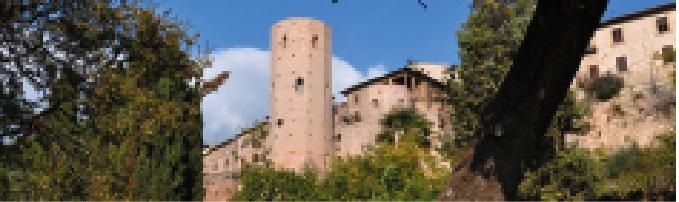
It was precisely during this period of consolidation that the Trinci understood Rasiglia’s strategic importance. The village stood along the Via della Spina, an important trade route linking Rome with the Adriatic coast, and overlooked the Menotre Valley, with its invaluable water resources. To control this vital crossroads, the Trinci built the Castrum et Roccha Rasilia, a fortress on the hilltop whose ruins can still be seen today, including sections of the defensive walls and the keep that once watched over the valley.
But the Trinci did not limit themselves to turning Rasiglia into a military outpost. They also understood the economic potential of its abundant, perennial waters. As early as the 14th century, under their rule, the village began to develop into an important production centre, with grain mills and fulling mills for processing cloth. This insight laid the foundations for the proto-industrial vocation that would make Rasiglia famous in the following centuries, when the Tonti and Accorimboni families developed the wool and textile industry, harnessing the same hydraulic power that the Trinci had first learned to channel.
The history of the Trinci is also intertwined with a bloody episode set in the territory around Rasiglia. In 1419, the castellan of Nocera Umbra, Pietro da Rasiglia, a trusted man of the Trinci, discovered that his wife was having an affair with Niccolò Trinci. Seeking revenge, Pietro invited Niccolò and his brother Bartolomeo on a hunting expedition and treacherously killed them in the fortress of Nocera. When Corrado Trinci learned of the murders, he laid siege to Nocera and took ruthless revenge, killing the castellan’s relatives in an episode that the chronicles referred to as “la fornicazione per bellezza”. The Trinci lordship came to an end in 1439, when Pope Eugene IV regained control of Foligno, but their legacy remained deeply embedded in the territory: in its palaces, fortresses and, above all, in the bond between Rasiglia and its waters, whose potential they had been among the first to develop.


