Aerial view of Castiglione del Lago at sunset, with the historic centre overlooking Lake Trasimeno.
Lake Trasimeno

An unusual itinerary around Lake Trasimeno

The territory of Castiglione del Lago is an open book on the history of the Umbrian landscape.

Here, along the western shore of Lake Trasimeno, layers of history intertwine: Etruscan necropolises dot the hills, Roman villas overlook the plain, rural farmsteads established during the Jesuits' agricultural reforms punctuate the countryside, and centuries of quiet transformation have shaped the region's vernacular architecture.

This itinerary goes beyond simply visiting places—it teaches visitors how to read the landscape.

Accessibility

The itinerary unfolds entirely within the municipality of Castiglione del Lago. The Rocca del Leone and Palazzo della Corgna are both within easy walking distance of the historic centre. Gioiella is approximately a ten-minute drive from Castiglione del Lago, while the Roman villa of Gioiella-Vaiano lies between the villages of Gioiella and Vaiano and can be visited by appointment only. The entire itinerary is most conveniently explored by car.

Marker
Stage 1
Castiglione del Lago – A Design of Power Between the Fortress and the Palace

The journey begins in the hilltop town overlooking Lake Trasimeno, once known as the "fourth island" of the lake because it was completely surrounded by water. Castiglione del Lago is a fortified town where religious and secular power have long shared the urban space in remarkable balance.

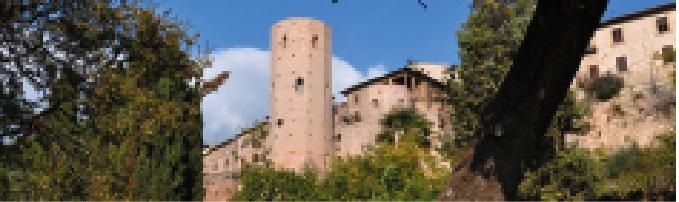
The Rocca del Leone (Lion Fortress), commissioned by Emperor Frederick II in 1247 and possibly designed by Friar Elias of Cortona, is one of the finest examples of medieval military architecture in Umbria. Its irregular pentagonal plan, with five towers dominated by a nearly thirty-metre-high triangular keep, makes it one of the region's most impressive fortifications. The ramparts offer breathtaking 360-degree views over the lake and the surrounding countryside. Today, the fortress courtyard serves as a natural amphitheatre for summer performances and Christmas events. It also preserves the remains of a small medieval church, currently under archaeological investigation, where Renaissance burials and fragments of polychrome frescoes have been uncovered, attesting to the site's long-standing sacred function.

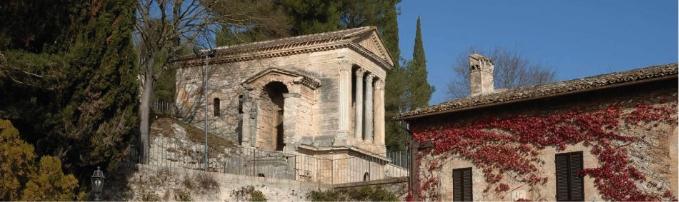
Just a few steps away, a striking covered passageway links the fortress to the Palazzo Ducale, also known as Palazzo della Corgna. Commissioned by Ascanio della Corgna in 1560 and possibly designed by Jacopo Barozzi da Vignola or Galeazzo Alessi, the palace is richly decorated with frescoes by Niccolò Circignani, known as Il Pomarancio, and Salvio Savini. These magnificent cycles celebrate the military exploits of the condottiero Ascanio della Corgna and represent one of the finest examples of Mannerist painting in Umbria. Now home to the Town Hall, the palace also houses the Civic and Archaeological Museum. While exploring the historic centre, visitors should also look out for the three medieval gates—Porta Fiorentina, Porta Senese and Porta Perugina - as well as the Church of San Domenico, built in 1636 and home to the tombs of the della Corgna family.
Read more
Marker
Stage 2
Gioiella – An Etruscan Village with Jesuit Heritage

A few kilometres west of Castiglione del Lago, on a hill overlooking the Valdichiana, lies Gioiella, a village of Etruscan origin that still preserves the charm of an ancient rural settlement. The Etruscans left behind a necropolis of thirteen chamber tombs, evidence of a community that flourished between the 2nd century BC and the 3rd century AD. During the Renaissance, Gioiella became the favourite hunting retreat of Ascanio della Corgna, who built a residence here, now known as Palazzo Dini.

Yet another, lesser-known chapter makes Gioiella particularly fascinating for those interested in cultural landscapes. In 1566, the Society of Jesus obtained extensive lands around the village under a perpetual emphyteutic lease, creating an unusually large agricultural estate for the local area. In 1766, the Bolognese surveyor and architect Francesco Maria Tiroli produced a Cabreo - an illustrated estate register - meticulously documenting the plans and elevations of the nine rural complexes owned by the Jesuits.

The Church of San Lorenzo, known locally as the "Chiesa Maggiore", is the principal surviving monument of this former Jesuit estate. Walking through the village today, visitors can still recognise traces of that past in the layered masonry, successive building extensions and the enduring layout of an agricultural landscape that has continually reinvented itself without ever entirely erasing its memory.

Read more
Marker
Stage 3
The Roman Villa of Gioiella-Vaiano – A Forgotten Luxury

Just a few kilometres from Gioiella, among the hills descending towards Lake Chiusi, lies one of the area's most significant archaeological sites: the Roman villa of Gioiella-Vaiano, the focus of an international excavation project since 2015.

The villa was occupied from the 2nd century BC to the 3rd century AD and overlooked a lacustrine landscape very different from today's. At that time, the Clanis River flowed slowly through the Valdichiana, feeding lakes and marshes that have long since disappeared.

Excavations have revealed an impressive bath complex with a partially preserved hypocaust (the Roman underfloor heating system) and a monumental nymphaeum featuring a water basin and walls decorated to imitate the interior of a natural grotto. The discovery of imported marble, amphorae and bricks stamped with the name LATALLIANI suggests that the estate belonged to a wealthy owner connected to commercial networks extending well beyond central Italy. The villa was therefore not merely an agricultural estate but also a prestigious residence designed to display wealth, status and power.

As the first Roman-period archaeological site in the area to be investigated scientifically, it offers an exceptional insight into the economic and social life of the ager clusinus during the Imperial period.

Read more
Marker
Stage 4
A Landscape That Tells Stories – Jesuit Farmsteads and Vernacular Architecture

The itinerary concludes with an immersion in the rural landscape surrounding Castiglione del Lago - a landscape that has never been static but has been continually reshaped by generations of farmers and the demands of everyday life.

Comparing Francesco Maria Tiroli's eighteenth-century drawings with the present condition of the Jesuit farmsteads of Gioiella - Prime Balze, Quarte Balze, Santa Lucia, Pontone, Sant'Eleuterio and Terze Balze - reveals an evolutionary process that also serves as a lesson in architecture. These rural buildings, often organised into three sections, expanded gradually through the addition of structures of varying sizes, while external staircases bear witness to successive vertical extensions. Fragile elements were demolished; solid ones were reinforced and replicated. In some cases, the original layout - a two-storey building, a stair tower and a lean-to annex - has been reproduced over time, almost as though it were part of the architecture's genetic memory. In others, such as the Pontone farmstead, doubling the building's size and adding a two-level portico transformed practical necessity into architectural quality.

This landscape, immortalised by Leonardo da Vinci in his map of the Valdichiana and described by Goethe as "extraordinarily delightful", is today a heritage worthy of careful protection. Every farmstead, every farmhouse and every surviving stone wall tells a story of adaptation and resilience, of hard work and ingenuity.

Read more