






Bufalini Castle
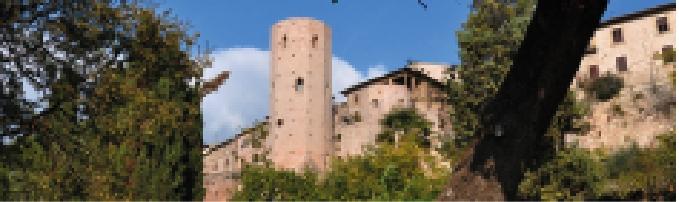
Surrounded by the greenery of the Upper Tiber Valley, Bufalini Castle in San Giustino is a rare and exceptional example of a Renaissance historic residence that has remained intact over time, even preserving its original furnishings.
The history of the castle, from defence to splendour
The building was originally constructed as a private fortress for the Dotti, a Ghibelline family from Sansepolcro. After the Battle of Anghiari (1440), it became a military outpost of Città di Castello, but was soon destroyed by order of the Florentine Republic.
In 1487, it became the property of Niccolò di Manno Bufalini, a member of a prominent noble family from Città di Castello. Reconstruction work then began based on a design by the Roman architect Mariano Savelli. The building thus took on the appearance of a true fortress, with a square plan, corner watchtowers – including a main tower – and a wide moat.
During the 16th century, the building lost its original defensive function. Giulio II Bufalini had it transformed into an elegant country villa inspired by the Medici style, entrusting the work to the Florentine architect Giovanni di Alesso, known as Nanni Unghero, a pupil of Antonio da Sangallo the Younger. Spacious halls were created around a courtyard with two arcaded sides inspired by Vasari, together with a loggia and a monumental entrance. The work was not completed until around 1560, however, with an intervention traditionally attributed to the celebrated architect Jacopo Barozzi, known as Vignola. On this occasion, the Counts Bufalini commissioned the decoration of the palace from the Mannerist painter Cristoforo Gherardi, known as Il Doceno, an exponent of the most fashionable artistic trends of the time.
During the last decade of the 17th century and the early years of the 18th century, Count Filippo I Bufalini and his wife Anna Maria Bourbon del Monte had the castle renovated once again, following a design by Giovanni Ventura Borghesi (1640–1708), an architect and painter from Città di Castello. It was thus transformed into a charming country villa with an Italian-style garden and a maze, in keeping with the fashion of the time. Meanwhile, the Bufalini family, who had become marquises, enriched the palace with numerous works of art in the late Baroque style, including frescoes, paintings and luxurious furnishings.
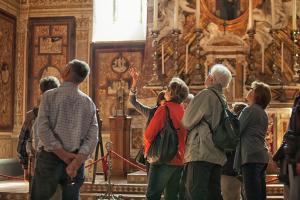
In 1988, Bufalini Castle was acquired by the Italian State and transformed into a museum.


