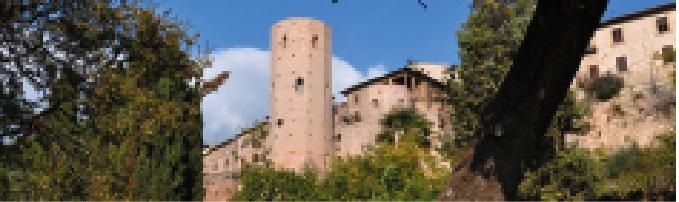
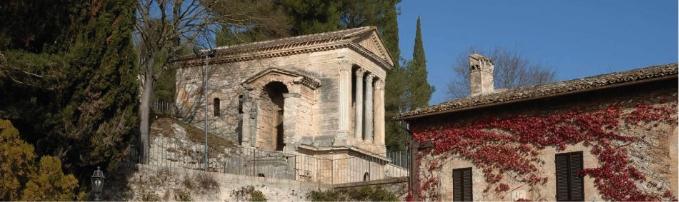
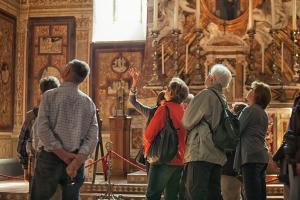
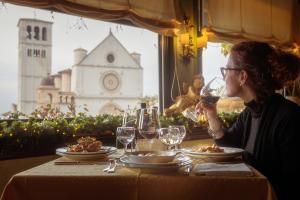





Amelia is a well-kept secret. Perched on a hill overlooking the Tiber Valley, this small town is not only one of the oldest villages in Italy, but a true journey through time, infused with the scent of holm oaks, fine olive oil, and millennia of history. Massive polygonal Roman walls embrace the town, and within them different architectural styles coexist in remarkable harmony.
Ancient Ameria, the oldest settlement in Umbria
This Umbrian town has extremely ancient origins. In his Naturalis Historia, Pliny the Elder cites Cato the Elder, who in his Origines claimed that the foundation of Amelia dated as far back as 1134 BC, established by the mythical King Ameroe, son of Atlas, from whom the town took its name.
Legend or truth, archaeological evidence confirms that the earliest settlement developed between the 12th and 11th centuries BC through the settlement of Italic peoples. This development centered around the area of today’s acropolis, from which the surrounding territory could be controlled. Such dating places Amelia among the earliest Italic centres and, most likely, as the oldest settlement in Umbria. Beyond archaeological remains and written testimony, traces of the city’s earliest history survive in sections of megalithic walls built around the 7th–6th centuries BC, and in the later polygonal walls from the 4th–3rd centuries BC that ultimately gave the town its present layout, corresponding to today’s historic centre.
In 90 BC Amelia became a flourishing Roman municipium with the privilege of minting its own coinage. It reached its peak during the Augustan age, when it became part of Regio VI. During this period, ancient Ameria experienced intense public and private building activity, evidenced by luxurious domus with mosaic floors — such as those discovered beneath Palazzo Venturelli and Palazzo Farattini — as well as a forum with underground cisterns, a theater, an amphitheater, baths, paved roads, and sewer systems. Clearly, influential social classes lived here, wealthy enough to build sumptuous residences and invest in public works. Thanks to its strategic position along the Via Amerina, one of the main routes connecting Umbria and central Italy, Amelia became a key center for military communications and Roman expansion. After the Christianization of the area, it also lay along one of the oldest pilgrimage routes.
Besieged by the Goths, who besieged it in 548 AD, Amelia was occupied by the Lombards in 579 and later became an important stronghold along the so-called “Byzantine Corridor,” a strategic route that played a fundamental role for the Eastern Roman Empire in Italy.
Around 1065 Amelia became a free commune. A Guelph city, it was sacked by the troops of Frederick II in 1240. In the 14th century it was finally brought under the control of Cardinal Albornoz and incorporated into the Papal States until the unification of Italy in 1861. During the Renaissance, splendid private palaces were commissioned by the city’s noble families, many of whose members held prestigious positions within the Roman Curia, including the Nacci, Farattini, Venturelli, and most notably the Geraldini family.
Wandering through ancient walls, alleys, and palaces
Amelia’s most important monument is undoubtedly its polygonal walls, built between the 4th and 3rd centuries BC using enormous stone blocks fitted together with remarkable precision and without mortar. They can be explored along a clearly marked urban trekking route Six gates open along the walls, four of which are still in use today: Porta Romana, the town’s main entrance; Porta Leone IV, named after the pope who restored the walls in the 9th century; Porta Posterola, from the Late Latin word meaning “secondary entrance”; and Porta della Valle, overlooking the Amerina Valley.
Near Porta della Valle survives a section of older megalithic walls that once formed the entrance to the pre-Roman acropolis. This earlier fortification was demolished following the town’s expansion. The enormous size of its stone blocks led people over time to call them “cyclopean walls,” believing they had been built by the Cyclopes — the giant sons of Uranus and Gaia — the only beings capable of moving such immense stones.
Important Roman-era remains are preserved in the Civic Archaeological Museum, housed inside the former convent of San Francesco. The collection includes inscriptions, urns, steles, boundary stones, statues, and other artefacts documenting the development of ancient Ameria during the Italic, pre-Roman, Roman, and Late Antique periods. Among the highlights is the magnificent bronze statue of Germanicus, a Roman general and consul of the Julio-Claudian period, dating to the 1st century AD. It is considered one of the best-preserved and most remarkable imperial statues of its kind.
One wing of the former convent also houses the “Edilberto Rosa” Art Gallery, displaying paintings from local churches and the surrounding area dating from the 15th to the 18th century. Among the masterpieces is Saint Anthony Abbot (c. 1474) by the Renaissance painter Piermatteo d'Amelia.
Among the town’s most notable monuments are the Cathedral, originally built in the 11th century with its dodecagonal bell tower; the Benedictine monastery of San Magno, home to important 17th-century paintings; the church and convent of San Francesco, featuring a Romanesque façade partially rebuilt during the Renaissance and a beautiful 16th-century cloister; the 13th-century church of Sant’Agostino, medieval on the outside and Baroque inside; and the 17th-century church of Santa Monica. Just outside the walls, do not miss the rural church of Madonna delle Cinque Fonti, where, according to legend, Saint Francis of Assisi stayed in 1213.
Amelia also hides fascinating wonders underground. From Piazza Matteotti visitors can access the ancient Roman cisterns, a hydraulic engineering masterpiece built in the 2nd century AD. Ten interconnected underground chambers once guaranteed the city’s water supply and today provide a cool, silent, and atmospheric refuge, especially during the summer heat.
Stroll through the narrow alleys, admire panoramic viewpoints, and enjoy the elegant late Renaissance palaces built during the city’s golden age under the patronage of noble families. Among them are the 15th-century Palazzo Nacci and the 16th-century Palazzo Farattini and Palazzo Petrignani. Finally, visit the splendid 18th-century theater commissioned by the local nobility and bourgeoisie in 1782.
Amelia is not just a destination — it is a state of mind. It is authentic Umbria, far from mass tourism, where every stone has a story to tell.
In the greenery surrounding the town
About three kilometers from the historic centre, set amidst the natural landscape of the, stands the beautiful convent of the Santissima Annunziata, built in the 15th century on the site of an earlier hermitage.
The landscape surrounding Amelia remains largely unspoilt, dominated by the vast holm oak woods of the Monti Amerini, ideal for trekking, cycling, and horseback riding. Among the area’s natural attractions is the Rio Grande stream, which forms a small lake called Lago Vecchio, accessible via a footpath and popular among fishing enthusiasts. Nature lovers should also visit the beautiful “La Cavallerizza” park, located four kilometres from town within a dense holm oak forest.
Local delicacies to savour
No visit to Amelia is complete without tasting Girotti figs: a traditional local delicacy made of dried figs stuffed with walnuts, almonds, or candied fruit and pressed into traditional handmade discs. For a hearty soup or first course, try fava cottora, a special variety of broad bean unusually small yet unmistakable in flavor.
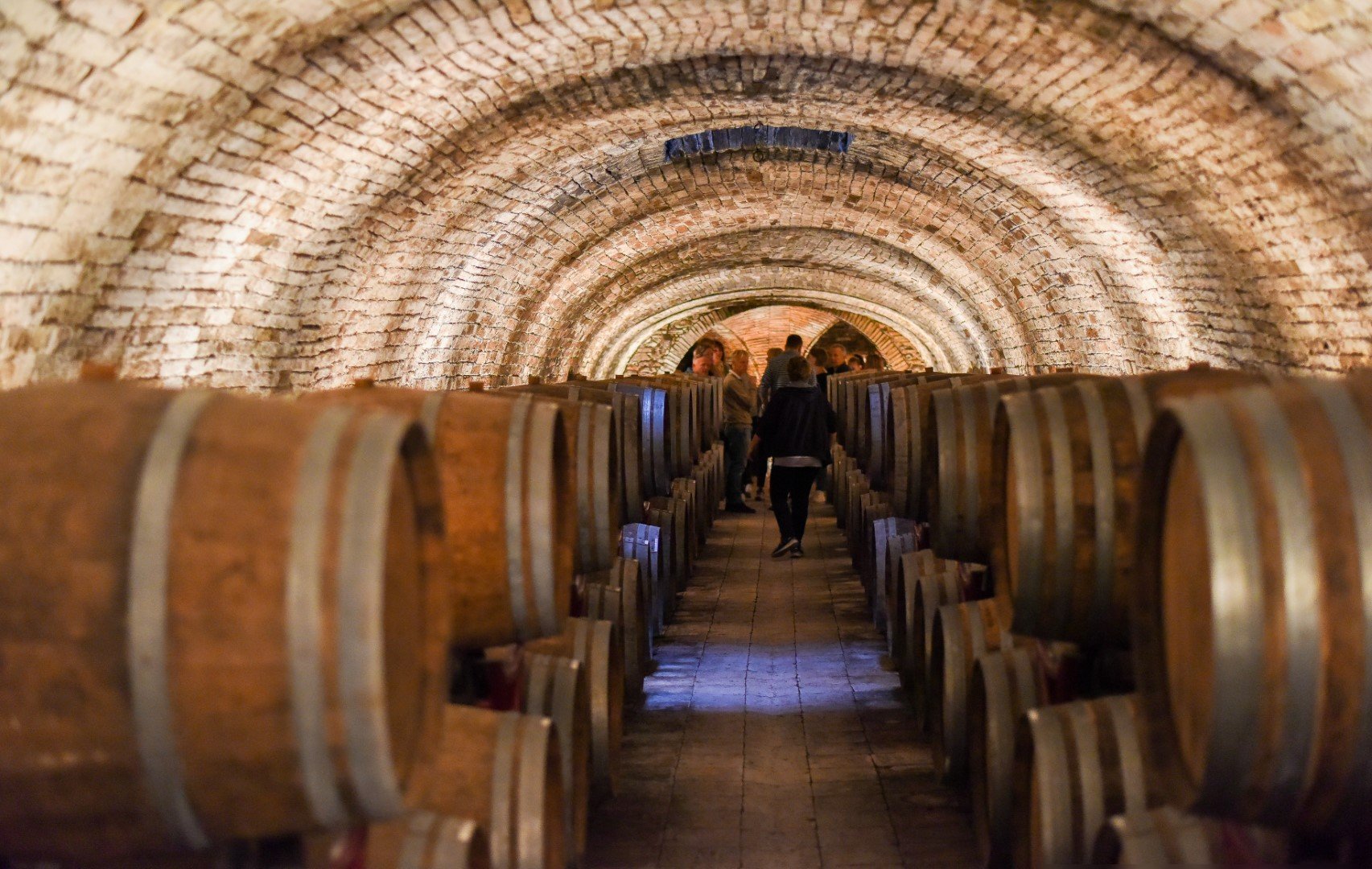
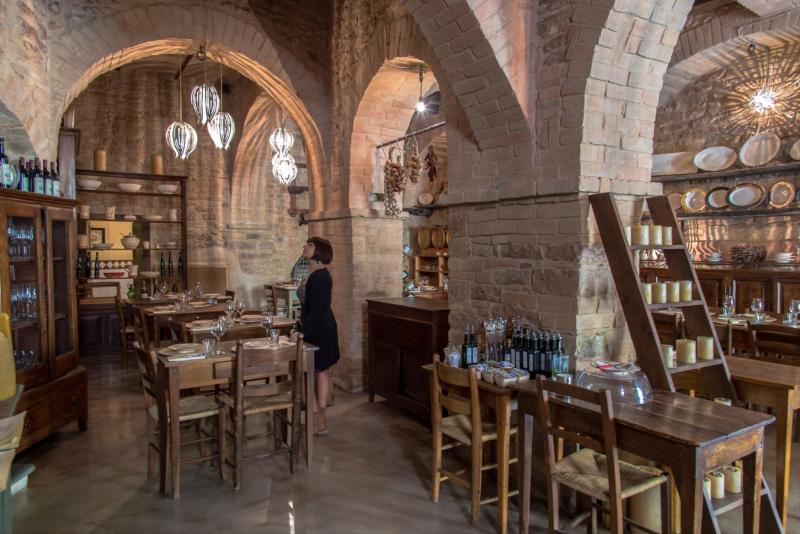
The hills surrounding the town produce the prized Colli Amerini olive oil: a liquid gold with a bold flavor, perfect drizzled over unsalted Umbrian bread. Pair it with a good glass of local DOC red wine while watching the sun set behind the hills.
One final suggestion: visit Amelia during the Palio dei Colombi between July and August. The town comes alive with flag throwers, medieval costumes, and equestrian competitions that transport visitors straight back to the 14th century.